Change Management
Our change management approach is grounded in the EXD Framework – friction-specific, behaviourally-led, and measured before and after. We do not manage change for organisations. We build the conditions in which people choose to change.

“Change cannot be put on people. The best way to instil change is to do it with them – to create it with them.”
However well-meaning, change imposed on people is rejected. Our change management services are centred around ownership – the idea that the people affected by a change are the ones who make it work.
WHAT IT IS
Friction-specific behavioural change
Most change management programmes start with a communications plan. Ours starts with a friction diagnosis. We identify the specific behaviours, processes, and conditions that will resist change – and design interventions that address those frictions directly, rather than communicating around them.
This is grounded in the EXD Framework – tools that bring HR, Facilities, IT, and Leadership into a shared agenda before any change communication is designed.
The result: change that sticks because it was built to remove friction, not layered on top of it.
What the engagement produces
CHANGE READINESS ASSESSMENT
Friction-mapped analysis of resistance points – who will resist, what they will resist, and why – before change begins.
STAKEHOLDER ENGAGEMENT PLAN
A co-created engagement strategy covering all stakeholder levels – not a broadcast communication plan.
EXD SCORE- BEFORE & AFTER
Perception measured at baseline, at the point of change, and at 3 months post-change. Evidence that the change worked.
POST OCCUPANCY EVALUATION
Structured review at 30 and 90 days post-change. Behaviour observed. EXD Score remeasured. Adjustments recommended.
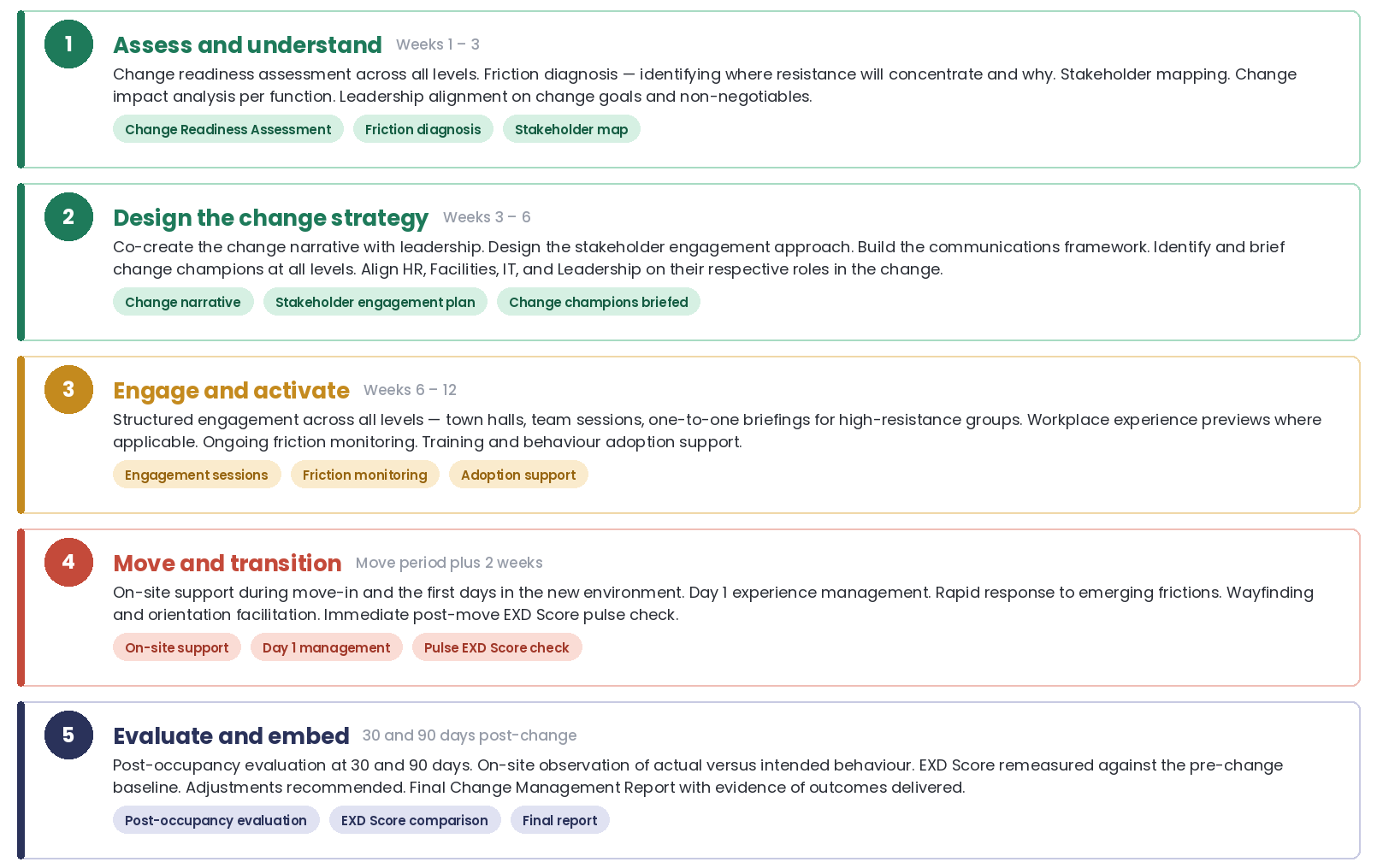
A five-phase engagement model
When delivered alongside Workplace Strategy, phases 1 and 2 run in parallel – research insights are shared, not duplicated.
What makes our approach different
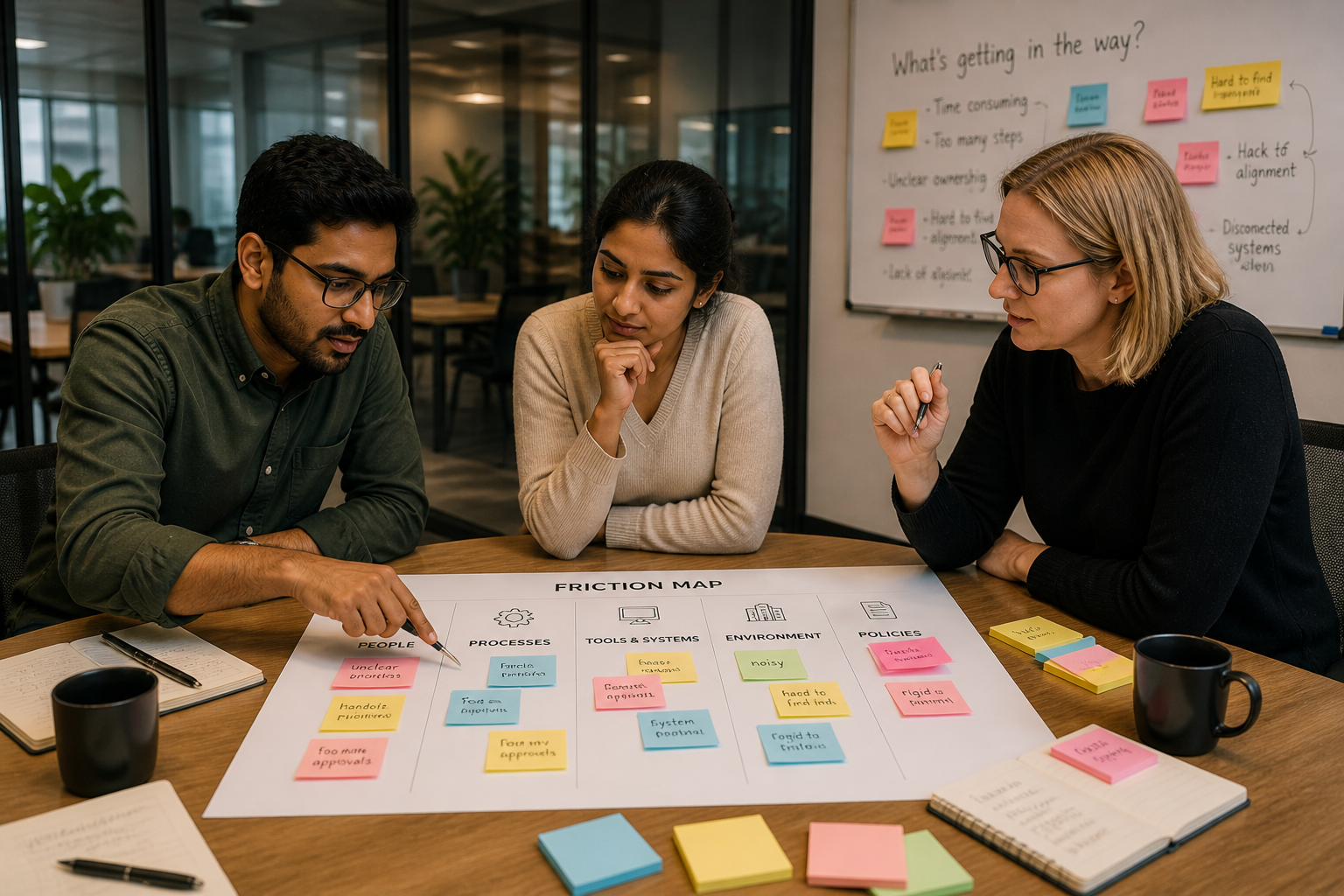
We start with friction, not communications
A communications plan addresses awareness. It does not address the specific process, spatial, or behavioural frictions that cause people to resist. Our diagnosis finds those frictions before they become problems.

We measure outcomes, not activity
Most change programmes report on activities – sessions run, communications sent, people trained. We report on outcomes: EXD Score movement, observed behaviour change, and sustained adoption at 90 days.

We stay through move-in
The first days in a new environment are when friction concentrates and resistance crystallises. On-site support during and immediately after move-in is where the change is won or lost – most consultancies are not there for it.
STRONGER TOGETHER
Workplace Strategy and Change Management delivered by one team
When both workstreams are delivered together, the insights from the strategy research flow directly into the change programme. Stakeholder engagement done in strategy becomes the foundation for change management. No re-briefing. No duplication. No gap between what the strategy says and what the change programme does.
This is how we work on most engagements – and it is why our outcomes are stronger than when the two workstreams are managed by separate teams.
research
Research from Workplace Strategy feeds directly into the Change Readiness Assessment.
stakeholder maps
Stakeholder maps built once, used across both workstreams.
EXD score
EXD Score baseline locked in Workplace Strategy becomes the Change Management benchmark.
single point of contact
One point of contact for the client across both workstreams.
Watch this short video on the basics of Change Management from Blend.