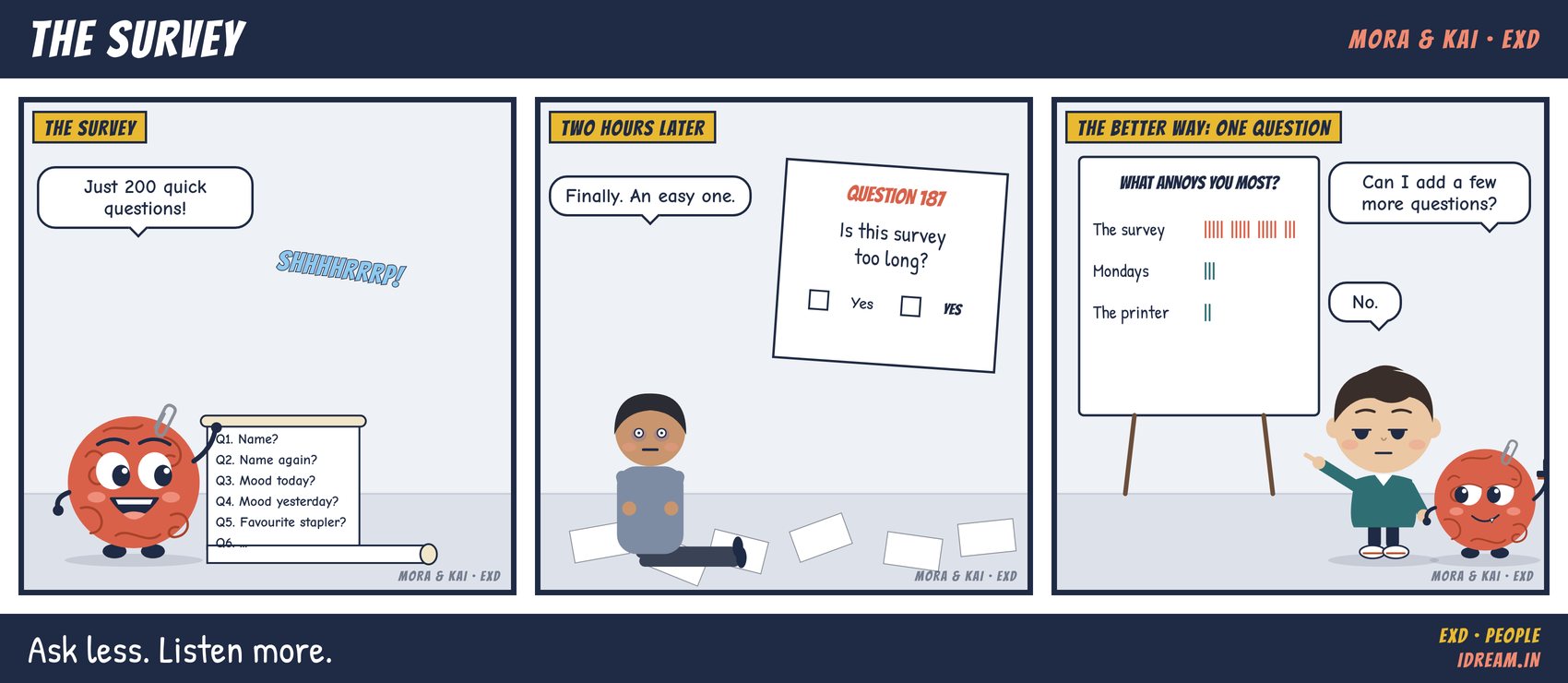
Mora’s survey had 200 questions. Question 187 asked, “Is this survey too long?” By then nobody was reading. Kai asked one question, “What annoys you most?”, and got answers he could fix by Friday.
Most organisations have run some version of Mora’s survey. It arrives with a deadline and two reminders, people grit their teeth and get through it, and then nothing visible happens for nine months. The next year, fewer people bother. The ones who do answer faster and say less.
Why it happens
Length is rarely the real problem. People will give twenty minutes to a questionnaire if they believe it leads somewhere. What wears them down is the feeling that their answers go into a drawer.
The mechanism is simple. Every question nobody intends to act on costs the respondent attention and gives nothing back. Surveys grow because each department adds “just one more” question and nobody owns the job of taking any out. The results come back as a sixty-slide deck, leadership reads the summary page, and the follow-up quietly dies. Employees notice. They learn that the honest answer and the quick answer have exactly the same effect, so they choose the quick one.
So survey fatigue is mostly a memory: people have answered too many surveys that changed nothing.
There is a second, quieter cause. Many surveys are designed to produce a number for the annual report, an engagement percentage that can be compared with last year. A question that serves a headline figure is not the same as a question that serves a decision. People can tell the difference, even if they couldn’t name it.
What it really costs
Rough maths for an organisation of 2,000 people. Say the annual survey takes 25 minutes. That is about 830 hours of working time before anyone starts the analysis. At an illustrative cost of ₹1,500 an hour, the survey costs around ₹12.5 lakh in time alone.
That is money well spent if the answers drive decisions. If they don’t, the larger cost is trust. Each ignored survey lowers the response rate and the honesty of the next one, until the data mostly tells you what people think you want to hear. At that point you are paying to be misled, and making decisions on the strength of it.
What to do instead
- Run the act-on-it test. For every question, name the person who will own the result and the decision it could change. If nobody can be named, cut the question. What remains is your survey.
- Keep a steady, regular check. A fixed set of questions asked the same way every quarter shows movement over time. A one-off survey gives you a snapshot, and snapshots are easy to argue with.
- Add one open question. Something close to Kai’s “What annoys you most?” The structured questions tell you where to look. The open answers tell you what to fix first.
- Report back within a month. Tell people what you heard, what you will change, and what you won’t change and why. A plain “you said, we did” note is what earns an honest answer next time.
The last step matters most. A short survey with no follow-through teaches people the same lesson as a long one: answering is pointless.
One more habit worth adopting: share the raw open answers, lightly anonymised, with the managers whose teams wrote them. A summary chart says “Process scores fell”. A dozen comments about the travel booking tool say exactly where to start on Monday.
Through the EXD lens
Surveys belong to the People dimension of the EXD Framework because they are a conversation, and a conversation only works if both sides listen. The EXD Score asks 50 questions across People, Process, Place, Technology and Culture each quarter, and every one of them maps to something a leader can change. Asked the same way over time, and followed by visible action, those questions show whether things are getting better or worse. Length was never the test. Usefulness is.
Try this tomorrow: beside each question in your last survey, write the name of the person who acted on the answer, then count the blanks.
Mora & Kai is a cartoon series from iDream about the small frictions that make work harder. Each strip maps to one of the five dimensions of the EXD Framework: People, Process, Place, Technology and Culture.
Where is friction building up in your organisation? An EXD Audit finds it and puts a cost on it. Or bring your leadership team to the next IIT Hyderabad executive programme on employee experience.