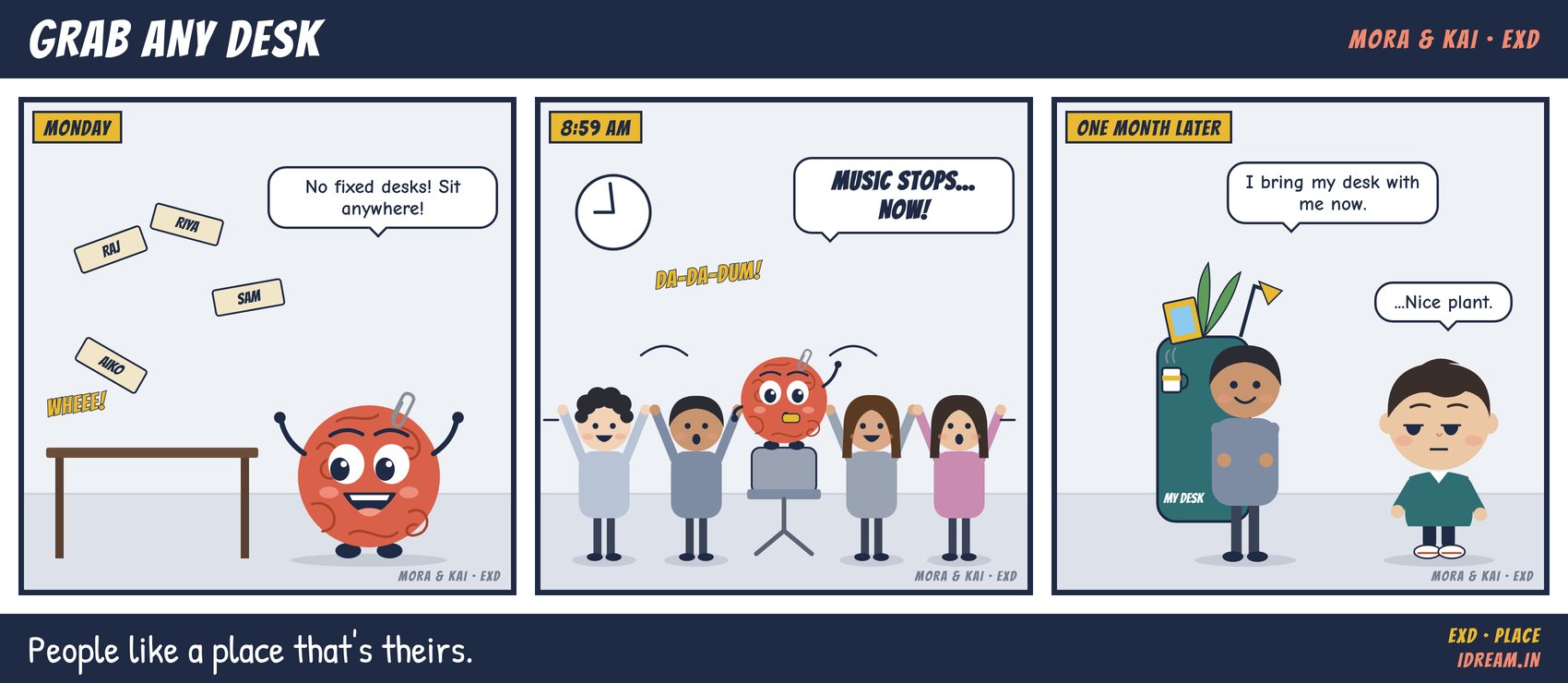
“No fixed desks! Sit anywhere!” By 8:59 am it is musical chairs, and Mora is standing on the only chair left. Raj, wiser now, carries his desk on his back.
Shared desks have become standard in many offices, and for good reason: on many days, plenty of assigned desks sit empty. But anyone who has arrived at 9:45 on a Tuesday knows the other side. Laps of the floor with a laptop bag, and a team scattered across the building. The day starts with hunting rather than working.
Why it happens
Most desk-sharing plans are built on average attendance. Facilities looks at badge data, sees that the office is, say, 60% full on a typical day, and sizes the desk count to match. The trouble is that nobody comes in on a typical day. People come in when their team comes in, and teams choose the same days. Tuesday and Wednesday fill up, Friday stays empty, and the average describes a day that never happens.
The second cause is less about numbers. An assigned desk did more than hold a monitor. It told people where they belonged and where to leave a coat. Remove it without replacing those signals and people feel homeless at work. So they compensate: arriving early to grab the same spot, or simply staying home.
What it really costs
Say 400 people come in on your busiest day and each spends 15 minutes finding a desk and finding their team. That is 100 hours of lost work on that day alone. With two peak days a week, rough maths gives around 200 hours a week, or about five full-time people doing nothing but looking for somewhere to sit.
The space saving can disappear in other ways. If the office is unpleasant on the days people are asked to come in, attendance drops, and leadership wonders why the expensive new floor is quiet. The real estate business case looked good on paper. On the floor it is costing the trust it needed to work.
What to do instead
- Size for the busiest day. Count how many people arrive before 10 am on your two busiest days, not the weekly average. Plan desk numbers against that figure, with a small buffer.
- Give every team a home base. A team zone, marked and known, means people know where their colleagues will be, even if the exact desk changes. It also stops one team from quietly taking over everyone else’s space.
- Provide a personal anchor. A locker close to the team zone. Somewhere to leave a bag and a spare charger, so people are not carrying the whole office in and out each day.
- Write booking rules that help, not police. Booking should take seconds and work on a phone. Release unclaimed desks by mid-morning. Avoid rules that need someone to patrol them. If the booking system is the main topic of complaint, it is part of the problem.
- Watch for the warning signs. Jackets on chairs at 7 am. Meeting rooms used as private desks. Teams quietly swapping their office days to avoid each other. People eating lunch at their laptops in the corridor. Each one tells you supply is short or the anchors are missing.
Shared desks work when people trust that a good place will be there for them. Once that trust is in place, the space saving tends to hold. Without it, people find their own ways to claim a desk, and the plan quietly turns back into fixed seating.
Through the EXD lens
This is the Place dimension of the EXD Framework: whether the physical workplace supports the work people come in to do. Desk sharing changes how a floor feels quickly, and badge data alone will not tell you how it is landing. Asking people about their workplace every quarter, as the EXD Score does, picks up the early complaints while they are still easy to fix.
Try this tomorrow: on your busiest day, count how many people arrive before 10 am, then count the desks.
Mora & Kai is a cartoon series from iDream about the small frictions that make work harder. Each strip maps to one of the five dimensions of the EXD Framework: People, Process, Place, Technology and Culture.
Where is friction building up in your organisation? An EXD Audit finds it and puts a cost on it. Or bring your leadership team to the next IIT Hyderabad executive programme on employee experience.