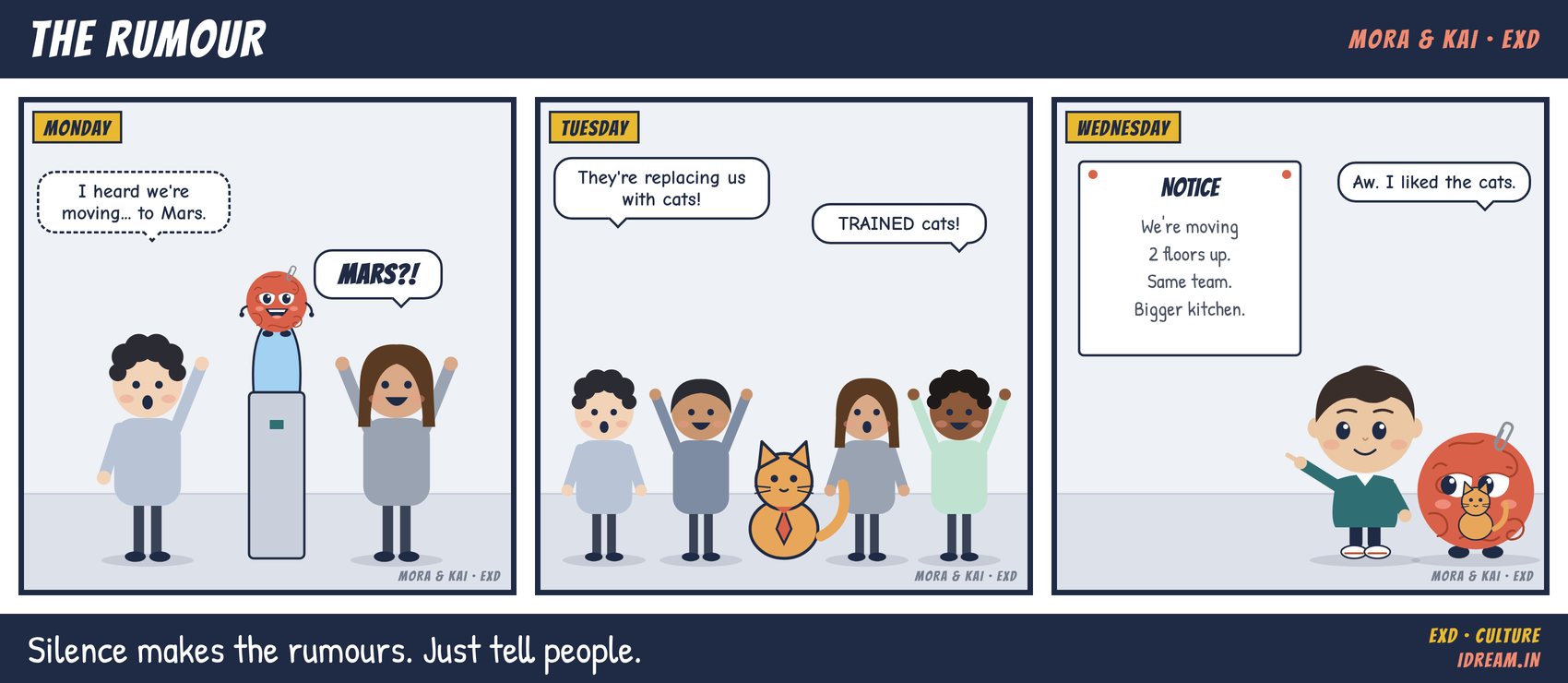
Nobody explained the office move. By Monday, the floor had decided the company was moving to Mars. By Tuesday, everyone was being replaced with cats. The truth, when it finally came out, was two floors up and a bigger kitchen.
Ask any leader who has been through a restructure or an office move, and they will tell you the rumours started before the first meeting. Often before the decision was even made. The silence at the top was meant to be careful. On the floor it was read as a cover-up.
Why it happens
People cannot plan around a blank. When a change is clearly coming and nobody explains it, the mind does what it always does with uncertainty: it fills the gap with the worst plausible story. Worst-case thinking feels safer than hoping for the best, so it spreads faster. A rumour about layoffs travels further than a rumour about a new coffee machine.
Leaders tend to stay quiet for understandable reasons. They do not want to announce something half-finished. Legal wants the wording checked. Some details really are confidential. So they wait until every answer is ready.
But the wait is not neutral. Every week of silence is a week in which the team writes its own version of events, and once a story has set, the official announcement has to fight it rather than simply inform.
What it really costs
Rumours eat attention. Take a team of 50 people spending, say, 30 minutes a day on corridor speculation and comparing notes over chai. That is 25 hours a day, or about 125 hours a week. Over a six-week rumour cycle, rough maths gives 750 hours, the equivalent of one person working for about five months.
The bigger cost is credibility. When the real news finally arrives, people judge it against the rumour and ask why they had to wait. Strong performers, who have options, start talking to recruiters during the silence just in case. Some of them do not come back from that conversation.
What to do instead
The fix is not to announce everything at once. It is to say what you know as soon as you know it, and to be explicit about the gaps. A simple structure for any update:
- What we know: “We are moving floors in the second quarter. Your team stays together.”
- What we don’t know yet: “We haven’t finalised the seating plan or the exact date.”
- When we’ll know more: “We will update you by the 15th, even if the answer is still ‘not yet’.”
That last line matters most. A date for the next update turns anxiety into waiting, and waiting is much easier to live with. Then keep the promise. Send the update on the 15th, even if it is two sentences long. A missed update does more damage than no promise at all.
Set a rhythm and stick to it for the life of the change: a short note every two weeks works for most moves and restructures. Use the same channel each time so people know where to look.
Two mistakes to avoid. The first is announcing too late, after the decision is visible. If the movers’ boxes arrive before the email, you are already behind. The second is briefing only managers and asking them to cascade. Managers are busy and get different versions of the message, and the gaps between those versions become new rumours. Tell everyone at the same time, then give managers a few extra details to handle questions.
Through the EXD lens
How an organisation talks about change sits in the Culture dimension of the EXD Framework: it shows people whether leadership treats them as adults who can handle an unfinished answer. Trust built this way grows slowly and can fall quickly in a single quiet month. Measuring it every quarter, rather than once a year, lets you see the dip during a change and respond before the rumour does.
Try this tomorrow: pick one change coming up in your area, and check whether your team has been told what you know, what you don’t, and when they’ll hear next.
Mora & Kai is a cartoon series from iDream about the small frictions that make work harder. Each strip maps to one of the five dimensions of the EXD Framework: People, Process, Place, Technology and Culture.
Where is friction building up in your organisation? An EXD Audit finds it and puts a cost on it. Or bring your leadership team to the next IIT Hyderabad executive programme on employee experience.