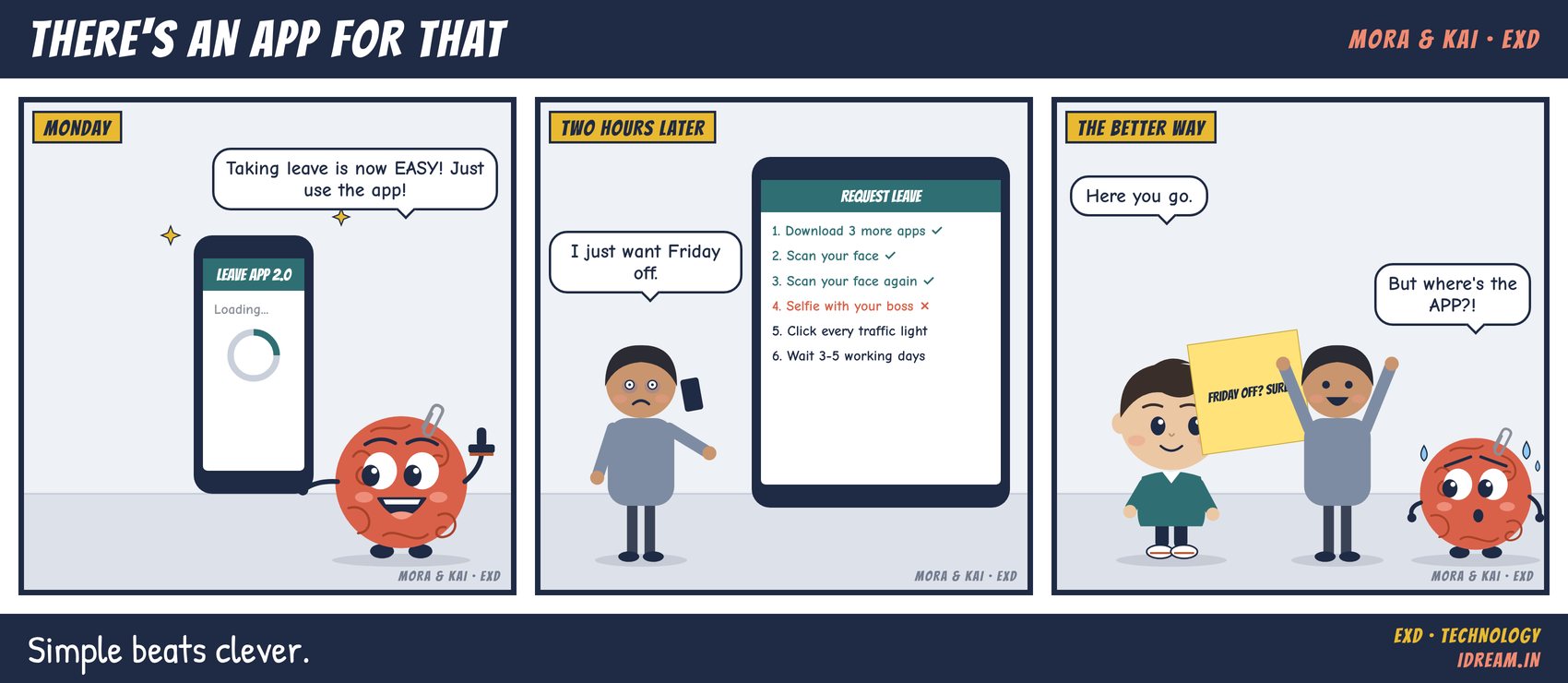
“Taking leave is now EASY!” announces Mora. Raj downloads the app, then another app the first one needs, then a third. Two face scans and a selfie with the Boss later, he still does not have Friday off. Kai hands him a sticky note. Ten seconds, done.
Nobody is suggesting a return to paper. But every leader has watched a new system arrive with a launch email promising to make life easier, and then watched simple requests take longer than they did before. Expense claims that need four approvals instead of one. A meeting room that can only be booked through a portal nobody remembers the password to.
Why it happens
Tools are usually bought to solve the organisation’s problem, not the employee’s. The leave app exists because HR needs an audit trail and finance needs accurate balances. Those are fair needs. But each one turns into a step the employee has to perform, and nobody adds up the steps from the employee’s side of the screen.
Then the system grows. Security asks for authentication. Compliance asks for a mandatory field. A manager asks for a comment box. Each addition is small and sensible on its own. Together they turn a ten-second request into a ten-minute chore.
The deeper cause is that success gets measured by adoption, not by speed. A rollout is declared a win when, say, most staff have logged in. Whether the task got quicker is rarely asked, because nobody timed it before the change.
What it really costs
Say a leave request used to take two minutes and now takes twelve. Across 1,000 employees taking, say, eight leave requests a year, that is 8,000 requests. Ten extra minutes each comes to around 1,330 hours a year. At an illustrative ₹1,200 an hour, that is about ₹16 lakh of working time spent on one small form. Now repeat the sum for expense claims and IT tickets.
The money is the visible part. The quieter cost is workarounds. People who find a tool painful stop using it properly. They email the manager directly, or keep their own spreadsheet on the side. The system’s data gets worse, which was the reason for buying it in the first place.
What to do instead
- Time the task before anything changes. Pick the five most common requests in your team. Ask two or three people to do each one while you watch with a stopwatch, from “I need this” to “it’s done”. Write the numbers down. This takes under an hour and settles most arguments about whether a tool is working.
- Time it again after. Three months after any rollout, repeat the test with the same tasks. If the time has gone up, the tool has a problem, whatever the adoption figures say.
- Design around the job. Start from what the person is trying to get done (“I want Friday off”) and work backwards. Every step that serves the system rather than the person should earn its place, or be automated out of sight.
- Count the steps, not just the minutes. Every login and every approval adds friction. A task with eleven steps will be abandoned halfway even if it is technically quick.
- Retire tools on purpose. When a new system arrives, name the old one it replaces and set a date to switch it off. If you cannot name one, you are adding a layer, not replacing one. And if a tool is slower than the thing it replaced, after a fair chance to fix it, retire it.
Put the stopwatch numbers in front of the vendor before you renew. It changes the conversation quickly.
Through the EXD lens
This is the Technology dimension of the EXD Framework, and the question it asks is simple: do the tools help people do their work, or do people work for the tools? Tools drift over time as features and approvals pile up, so a one-off check is not enough. Tracking how people rate their tools every quarter, alongside a few timed tasks, shows whether each change made work easier or just made it different.
Try this tomorrow: time your team’s most common request from start to finish, and ask whether it was quicker before the last tool change.
Mora & Kai is a cartoon series from iDream about the small frictions that make work harder. Each strip maps to one of the five dimensions of the EXD Framework: People, Process, Place, Technology and Culture.
Where is friction building up in your organisation? An EXD Audit finds it and puts a cost on it. Or bring your leadership team to the next IIT Hyderabad executive programme on employee experience.