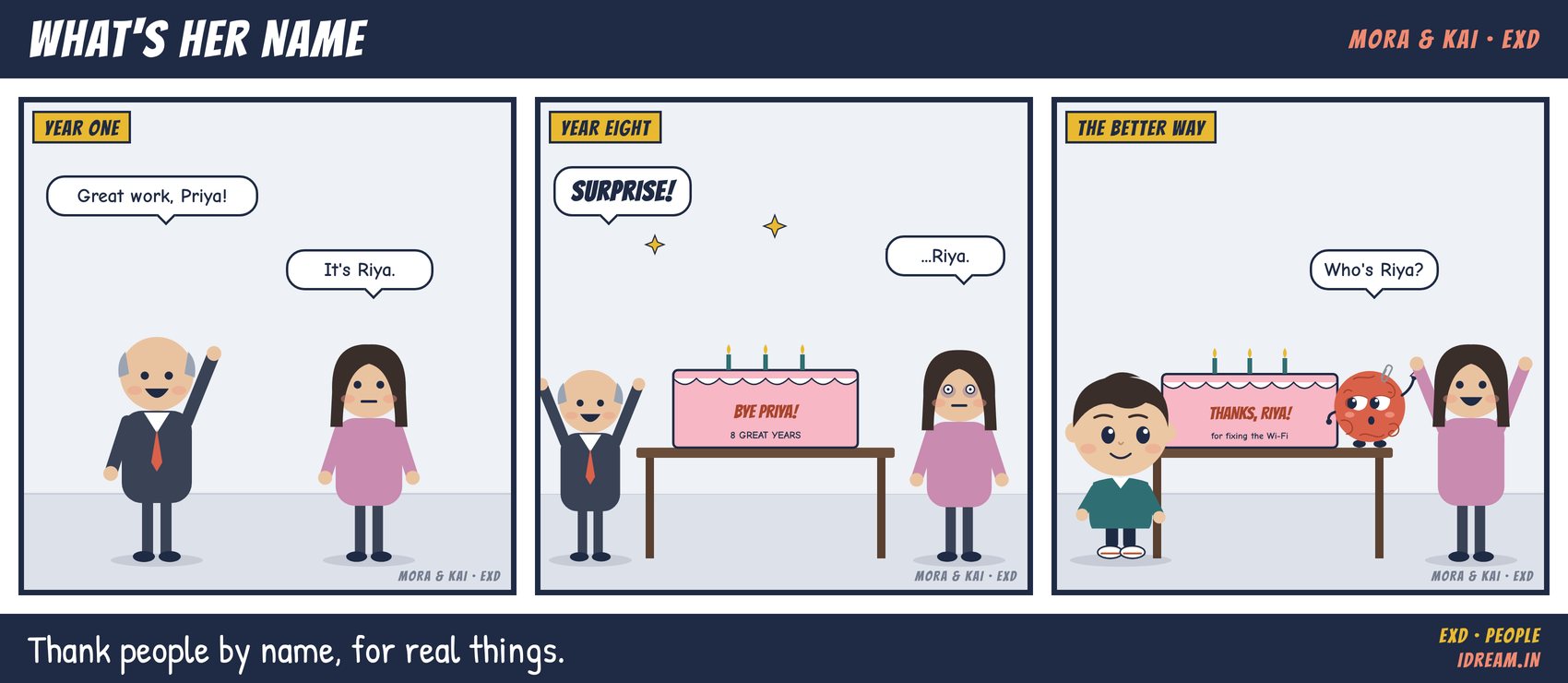
“Great work, Priya!” says the Boss. Her name is Riya. Eight years pass, nobody corrects it, and the farewell cake reads BYE PRIYA.
It is a cartoon, but most people have a version. The thank-you email sent to the whole team for something one person did. The annual award with the wrong project on the certificate. Each one is meant as praise. Each one tells the person that nobody was really looking.
Why it happens
Generic praise is a shortcut. A busy manager wants to be appreciative and has ten seconds, so the message gets written for the group, or copied from last time. It feels efficient.
The problem is what the receiver reads into it. A thank-you is evidence of attention. When it could have been sent to anyone, the evidence points the other way: you were not noticed, you were processed. So generic praise does not land as neutral. It lands as slightly negative, which is why some people would rather receive nothing at all.
There is a structural cause too. Many organisations treat recognition as an event: an annual ceremony or a points platform. Events concentrate thanks into a few big moments, chosen by committee, months after the work. By then the details have blurred and the manager is reaching for adjectives instead of facts.
What it really costs
The direct cost is close to zero, which is the odd part. A specific thank-you takes a minute to write. The cost of skipping it shows up elsewhere.
Say you have a strong performer who stays because they feel valued and might leave because they don’t. If replacing them takes three months of vacancy and three months of ramp-up, and their work is worth, say, ₹2 lakh a month to the business, the gap is in the region of ₹6 to ₹9 lakh before recruitment fees. Illustrative numbers, but the shape is real: the expensive part of recognition is not giving it.
There is a trust cost as well. When people see praise handed out vaguely, they stop believing any of it, including the praise that was sincere.
What to do instead
A good thank-you has three parts. Get all three right and it takes under a minute.
- The right name, said directly. To the person, not about them in a group email. Check the spelling. If you are unsure how to pronounce it, ask once and remember.
- The specific act. Not “great job on the launch” but “you rewrote the onboarding guide over the weekend and the new joiners stopped asking the same five questions”. If you cannot name what they did, you are not ready to thank them yet.
- Why it mattered. Connect the act to a consequence: the client renewed, or the audit passed without a finding. This is the part people remember, because it shows you understand their work.
Then make it a habit rather than an occasion. Block ten minutes at the end of each week, think back over what happened, and send one specific thank-you. Over a year that is around fifty messages, each written while the details are fresh. No platform needed.
Timing matters as much as wording. Thanks given the same day, while the work is still on everyone’s mind, carries far more weight than the same words at a review six months later. Do not save it up.
A useful check: read your message and ask whether it could be forwarded to someone else on the team without changes. If it could, rewrite it.
Through the EXD lens
In the EXD Framework, recognition belongs to the People dimension: how people are seen and supported by those around them. Managers tend to overrate how often they recognise their teams, because they remember intending to. Asking the team the same questions each quarter, as the EXD Score does, shows whether recognition is actually reaching people or only being planned.
Try this tomorrow: send one person a thank-you that names what they did and why it mattered, in a sentence that could only be about them.
Mora & Kai is a cartoon series from iDream about the small frictions that make work harder. Each strip maps to one of the five dimensions of the EXD Framework: People, Process, Place, Technology and Culture.
Where is friction building up in your organisation? An EXD Audit finds it and puts a cost on it. Or bring your leadership team to the next IIT Hyderabad executive programme on employee experience.