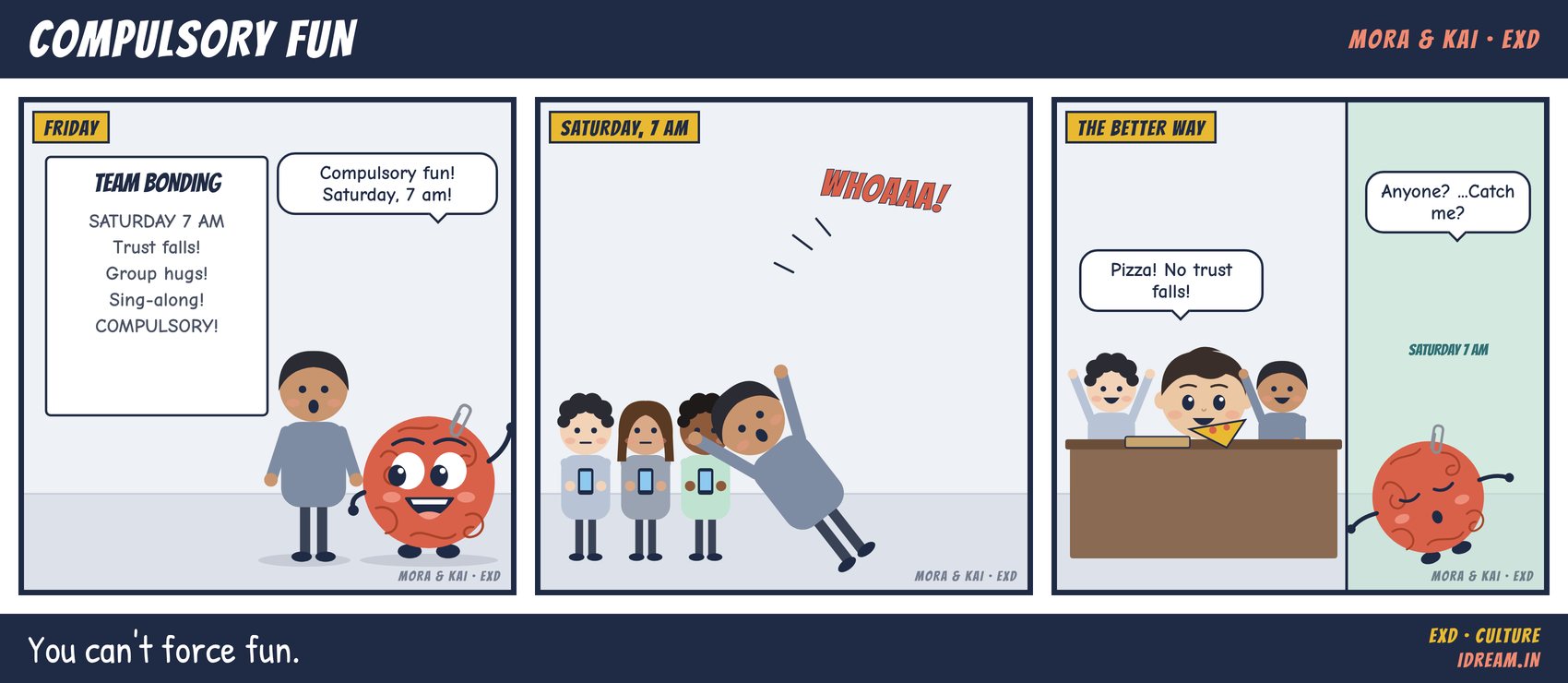
Saturday, 7 am. Mora has booked trust falls, and attendance is compulsory. Raj leans back, trusts his colleagues, and hits the grass, because every one of them is looking at a phone.
Most leaders have sat through some version of this. The offsite with the forced icebreaker. The Sunday cricket match nobody asked for, followed by a working Monday. The intent is good. The result is a team that smiles for the photo and quietly resents the calendar invite.
Why it happens
Team spirit is a by-product. It forms when people depend on each other and the dependence pays off: a handover that goes cleanly, or a colleague who covers for you when your child is ill. Trust is built from small proofs that someone will catch you, and those proofs happen at work, in the work.
Bonding events try to manufacture the by-product directly. That rarely works, and putting the event on personal time makes it worse. The message people hear is not “we value you”. It is “your weekend is ours too”. A leader who wanted to signal care ends up signalling ownership.
There is also a quieter mechanism. Compulsory events reward the people who find group activities easy: the extroverts, and the people with no caring duties at home. Everyone else experiences the event as a test they are failing. So the activity meant to include people ends up sorting them.
What it really costs
Take a team of 20 and a Saturday offsite of six hours, plus an hour of travel each way. That is 160 hours of personal time. Rough maths: if the team’s loaded cost averages ₹1,500 an hour, the company has spent the equivalent of ₹2.4 lakh in time it did not pay for, before the venue and the bus.
The bigger bill arrives later. People remember who took their Saturday. The parent who missed a school event, the employee who skipped a family function: they do not complain, they just trust a little less. And trust is the thing the event was supposed to build.
Then there is attention. A team that spends Monday tired and mildly irritated has lost a morning it will not get back. Multiply that by every offsite in the year and the bill is no longer small.
What to do instead
You cannot schedule team spirit. You can set up the conditions where it forms on its own.
- Ask first. Before planning anything, ask the team one question: what was the best team moment of the past year? The answers are usually small. A crisis handled together, or a long Friday lunch after a project shipped. Plan more of whatever they name.
- Keep it inside working hours. A two-hour lunch on a Thursday costs the company time, which is the point. It shows the gathering is valued enough to be paid for.
- Make it genuinely optional. If attendance is tracked, it is not optional. Let people opt out without explaining why, and do not mention who was missing.
- Celebrate wins when they happen. Fifteen minutes on the day a project lands beats a scheduled event three months later. Tie the gathering to something real the team did.
One more test before you send the invite: would you, as the leader, choose to go if it were not your idea? If the honest answer is no, rethink it.
Through the EXD lens
This sits in the Culture dimension of the EXD Framework: the unwritten rules about what the organisation expects from people, and what it gives back. Events on personal time quietly rewrite those rules. Culture is hard to see from the top, so it helps to ask the same questions every quarter, as the EXD Score does, and watch whether trust and belonging are moving up or down rather than guessing from the offsite photos.
Try this tomorrow: ask three people on your team to name their best team moment of the last year, and count how many of them mention an event you organised.
Mora & Kai is a cartoon series from iDream about the small frictions that make work harder. Each strip maps to one of the five dimensions of the EXD Framework: People, Process, Place, Technology and Culture.
Where is friction building up in your organisation? An EXD Audit finds it and puts a cost on it. Or bring your leadership team to the next IIT Hyderabad executive programme on employee experience.