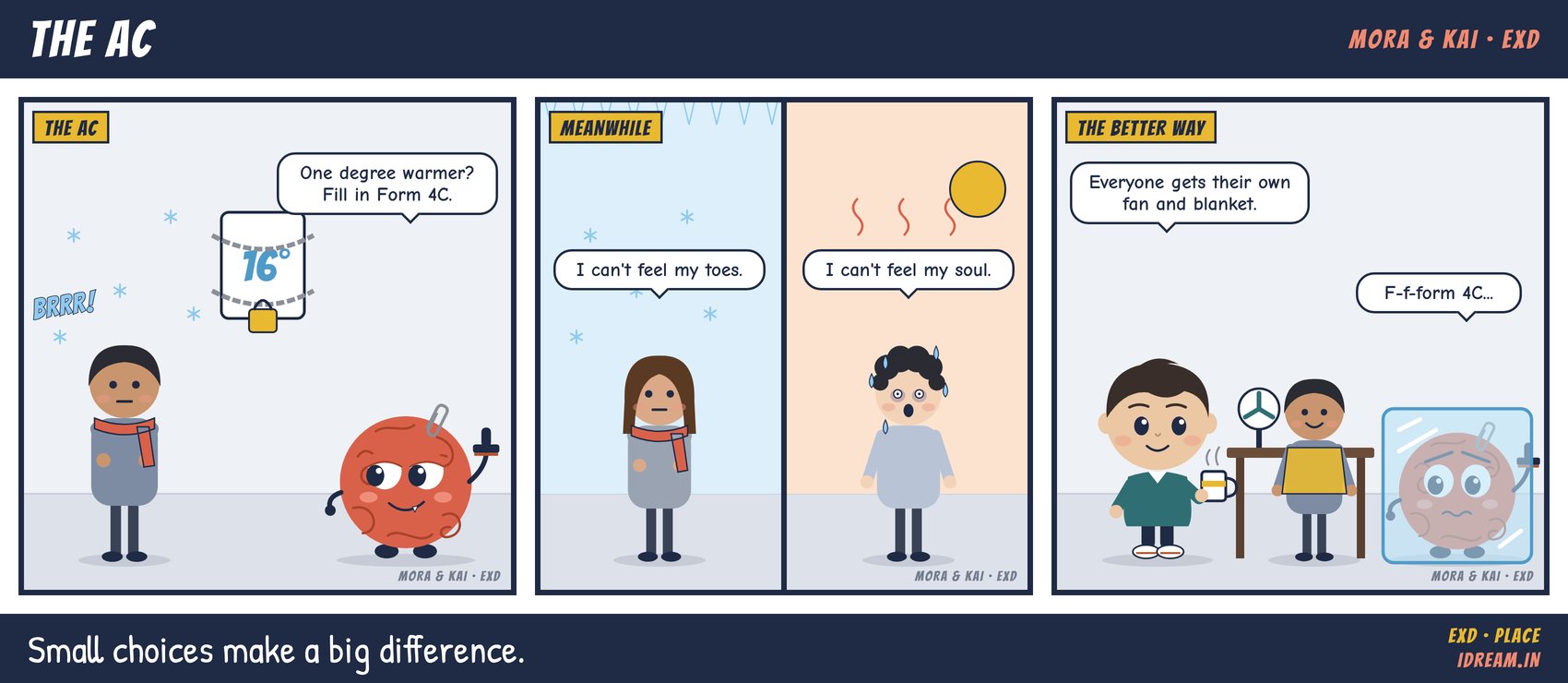
Sixteen degrees, locked. One degree warmer needs Form 4C. In this week’s strip, half the office wraps up in scarves while the other half melts, and Mora ends up frozen in a block of ice, still clutching the form.
Anyone who has worked in a glass office tower will know the real version: shawls kept permanently on chair backs in the middle of summer, and a helpdesk ticket marked “AC too cold” that reappears every single afternoon.
Why it happens
Central building systems are set for an average person sitting in an average spot. That person does not exist. People differ in what feels comfortable. A desk by the west windows takes the afternoon sun, while a desk under the vent sits in a cold draught. The same setting feels different at 11 am and at 3 pm.
So any single setpoint is wrong for a good share of the floor at any given moment. Locking it, so nobody can fiddle, swaps a technical problem for a human one. People still feel uncomfortable, and now they also feel powerless.
That second part matters more than it looks. Discomfort you can do something about is a passing irritation. Discomfort you cannot change, and must apply in writing to fix, turns into a grievance. People with a little control tend to put up with a lot more. A fan you can switch on yourself makes a warm afternoon bearable in a way a promise from facilities never will.
What it really costs
Comfort sounds like a soft issue until you put a number on it. Illustrative maths: suppose being too cold or too warm costs each person 20 minutes of real focus on a bad afternoon, and bad afternoons come three times a week. On a floor of 200 people, that is 200 hours every week, about five full-time people’s worth of attention lost to the thermostat.
Then add what sits outside the sum. Energy spent cooling a building to a temperature many find too cold. And people who quietly decide they simply work better at home, which leaves the expensive floor emptier than anyone planned.
There is a trust cost too. Form 4C tells people, every day, that the organisation does not believe they can be sensible about one degree. Small signals like that add up to a view of how much the place respects them.
What to do instead
Start cheap and local, well before anyone talks about replacing the chillers. Facilities teams often worry that giving away control will lead to chaos. In practice, a sensible range with clear limits solves most of the arguments before they start.
- Hand over small tools. Desk fans and a stock of light blankets cost very little and remove much of the daily irritation.
- Let people choose where to sit. Every floor has warmer and cooler zones. Name them openly and let people move between them.
- Replace the form with a range. Allow each zone to adjust within an agreed band, say 23 to 26 degrees, without asking anyone.
- Run a one-week comfort check. Ask everyone to rate their comfort at 11 am and 3 pm on a 1 to 5 scale, and to note where they sit. Map the results. Hot and cold spots usually cluster, and they show you exactly where to act.
Only after these, and with a week of comfort data in hand, does it make sense to discuss rebalancing the air handling. By then you will know which problem you are paying to solve, and which desks it affects.
Through the EXD lens
Thermal comfort belongs to the Place dimension of the EXD Framework, alongside light and noise. It is easy to dismiss as housekeeping, yet it shapes attention every hour of the working day. Checking Place each quarter also catches seasonal swings: a floor that feels fine in December can be unbearable by May.
Try this tomorrow: at 3 pm, walk the floor and count the shawls, jumpers and desk fans. Each one is a vote against the thermostat.
Mora & Kai is a cartoon series from iDream about the small frictions that make work harder. Each strip maps to one of the five dimensions of the EXD Framework: People, Process, Place, Technology and Culture.
Where is friction building up in your organisation? An EXD Audit finds it and puts a cost on it. Or bring your leadership team to the next IIT Hyderabad executive programme on employee experience.