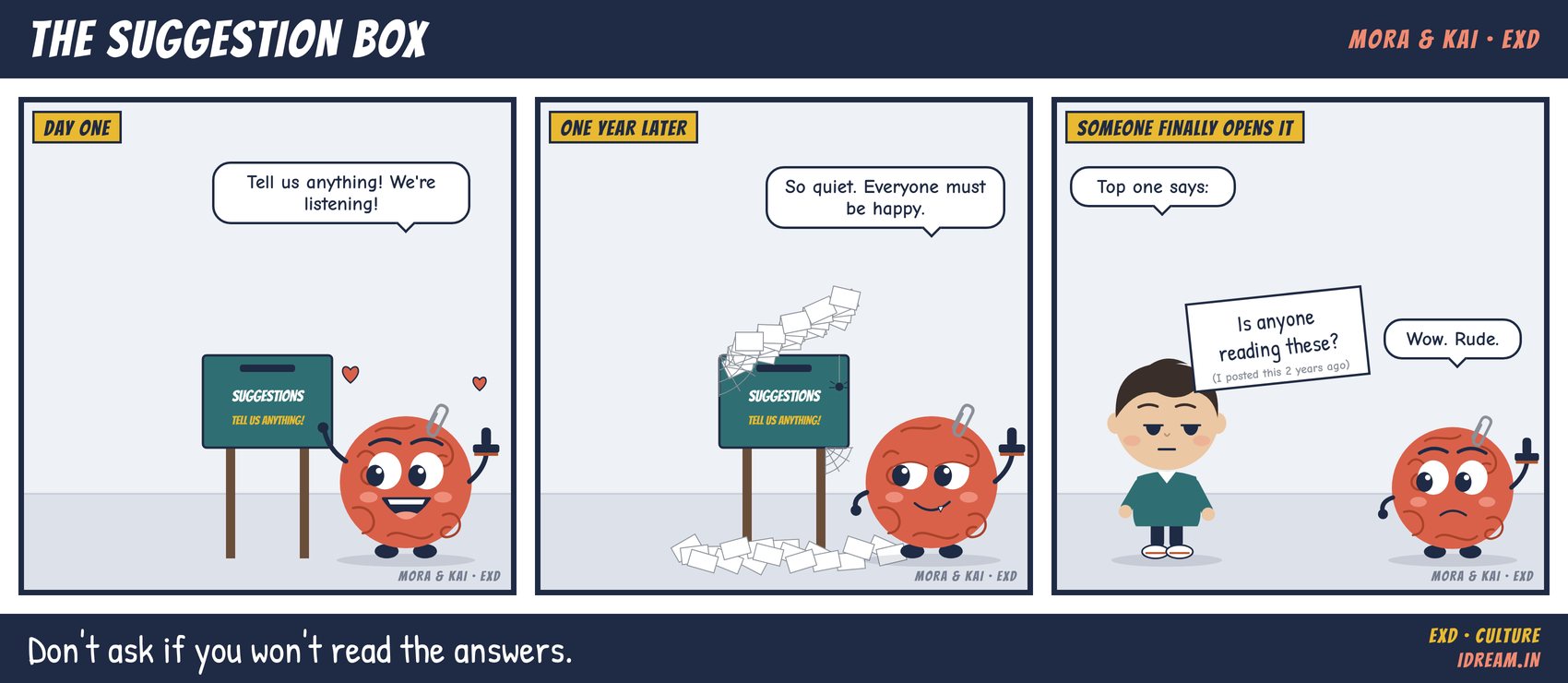
“Is anyone reading these?” That was the note sitting on top of the pile when Kai finally opened Mora’s suggestion box, long after the launch poster had promised “Tell us anything!”
Plenty of organisations have a version of that box. These days it is more likely to be an annual survey or an ideas portal than a wooden box by the lift. The format changes. The ending stays the same: people say something, and then hear nothing back.
Why it happens
Collecting feedback is easy, and it feels good. It signals openness. Acting on it is hard, because most suggestions land without an owner, a budget or a deadline attached. So they wait. Nobody decides to ignore them. They simply never get decided.
Here is the mechanism that makes this expensive. When you ask for feedback, you make an unspoken promise: we will listen. Silence breaks that promise. People do not conclude that leadership is busy. They conclude that speaking up is pointless, and they apply that lesson everywhere, including to the safety concern or the customer complaint you badly needed to hear.
Managers feel this most sharply. They are the ones asked “did anything happen with that?” at the coffee machine, and they rarely know the answer, because the decision, if any, was made two levels up.
That is why ignored feedback does more damage than no feedback. Never asking leaves people neutral. Asking and then ignoring teaches them to stay quiet.
What it really costs
The direct cost is lost ideas. Front-line staff see waste and risk that managers miss. As an illustration, if one suggestion in twenty would save ₹2 lakh a year, a box holding a hundred unread notes is sitting on about ₹10 lakh of savings.
The larger cost is silence. Once people stop speaking up, problems reach leaders late, after they have grown. The next survey gets fewer responses and blander answers. Each new feedback initiative is greeted with a raised eyebrow, because everyone remembers what happened to the last one. You end up paying for listening tools while hearing less than before you bought them.
What to do instead
You do not need a better box. You need a loop that runs on a fixed rhythm. Once a month suits most teams.
- Collect. Pull everything that came in, from every channel, into one list.
- Decide. A small group with real authority spends an hour on the list. Each item gets yes, not now, or no. Every yes gets an owner and a date.
- Report back. Publish the list as “You said, we did”. Include the noes.
The noes matter more than you would expect. A clear “no, because” keeps trust far better than silence does. Give the reason in a sentence, whether it is cost or a clash with another priority. People can accept a no. What wears them down is never finding out.
Then make the loop visible in one predictable place. A board by the pantry works. So does a monthly email from the business head. Pick one, and keep it going even in months when the list is short. Consistency builds more trust than any single big win, because it proves the loop is real.
Keep the decision group small and senior enough to say yes on the spot. If every item has to be escalated, the loop slows to a crawl and the monthly report starts to look like the old box.
One more thing: thank people by name when their idea goes ahead, with their permission. Nothing encourages the next suggestion like seeing a colleague’s last one come to life.
Through the EXD lens
This sits in the Culture dimension of the EXD Framework: the unwritten rules about whether it is safe, and worthwhile, to speak. Culture moves slowly, so one survey tells you little. Measuring it every quarter, through the EXD Score for instance, shows whether closing the loop is changing how heard people actually feel.
Try this tomorrow: find the last five suggestions your team received and check whether each person has heard back.
Mora & Kai is a cartoon series from iDream about the small frictions that make work harder. Each strip maps to one of the five dimensions of the EXD Framework: People, Process, Place, Technology and Culture.
Where is friction building up in your organisation? An EXD Audit finds it and puts a cost on it. Or bring your leadership team to the next IIT Hyderabad executive programme on employee experience.