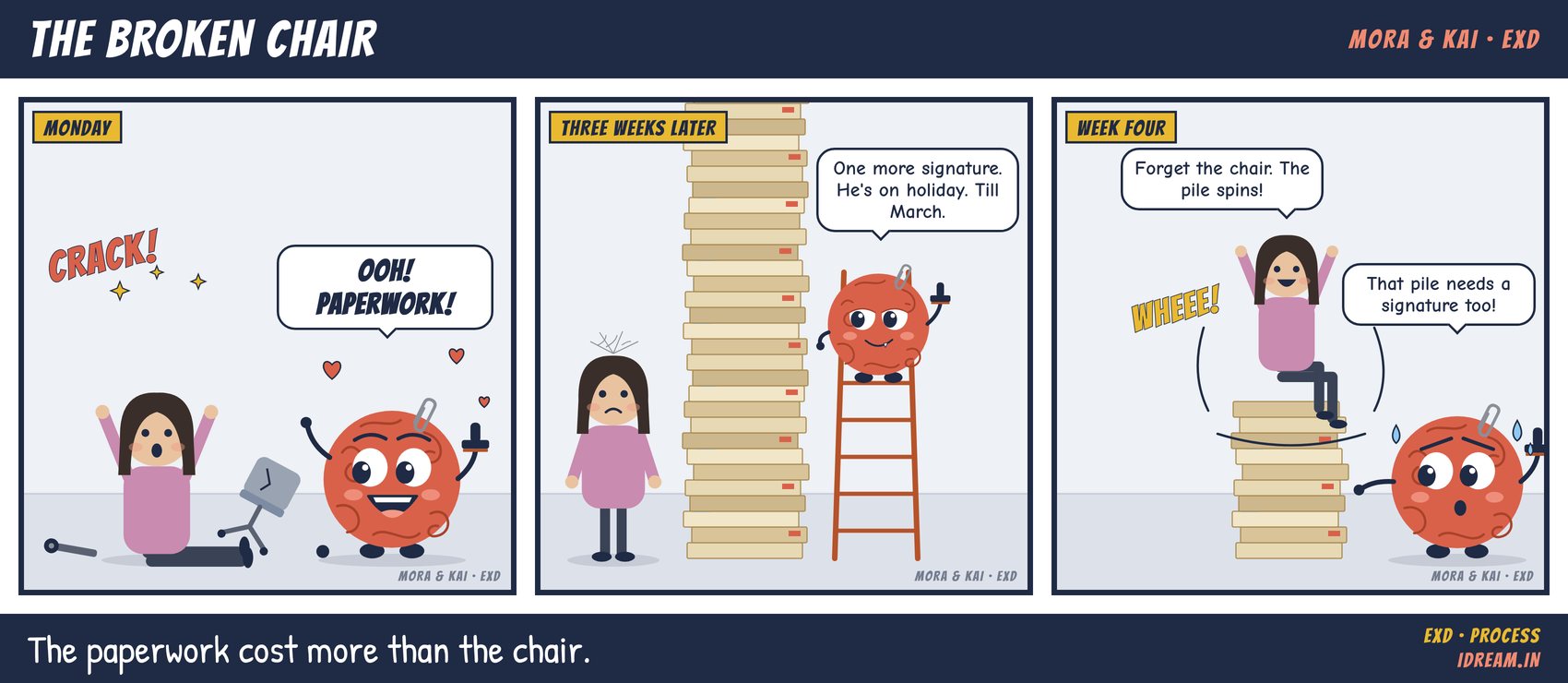
Riya’s chair broke on a Monday. Three weeks and 11 signatures later, a new one arrived. Mora stamped every form with great pride. Riya spent the wait working from whatever seat she could borrow.
Every organisation has a version of this. A laptop charger, a software licence, a visitor pass, a ₹600 taxi claim. The item is small and the request is obvious, yet it travels through a queue of people who each glance at it and pass it on. Nobody in the chain thinks they are the problem. Each of them is right, and the chain is still the problem.
Why it happens
Approvals are almost always added in response to a single bad incident. Someone once ordered a ₹90,000 chair, so finance added a check. A vendor once overbilled, so procurement added another. Each new signature is a sensible reaction to a real event.
The trouble is that signatures are easy to add and awkward to remove. Adding one looks prudent. Removing one looks careless, and if anything goes wrong afterwards, the person who removed it carries the blame. So the chain only ever grows. Ten years on, nobody remembers why step seven exists, but everyone is sure it must be important.
There is a second, quieter cause. The person approving rarely sees the cost of the delay. The manager signing on day nine does not feel Riya’s borrowed seat. The cost lands on someone else, so it never shows up in anyone’s decision.
What it really costs
The cost has two parts: the waiting time of the person asking, plus the minutes spent by every approver. Here is the rough maths for Riya’s chair, using illustrative numbers.
- Say Riya costs the company around ₹7,000 a working day. On a bad chair she works at, say, 80% of her usual pace. That is ₹1,400 a day lost, over 15 working days: about ₹21,000.
- Eleven approvers spend ten minutes each, including reading, chasing and replying. That is nearly two hours of mostly senior time. At an illustrative ₹1,500 an hour, about ₹3,000.
Total: roughly ₹24,000 to approve a ₹4,000 chair. The control cost six times what it was protecting.
The money is only part of it. Riya learned something in those three weeks: that a simple, reasonable request is treated as a risk. People who learn that stop asking. They buy things themselves, work around the system or quietly put up with poor tools. None of that appears on a report, and all of it costs more than the chair.
What to do instead
- Map your five most frequent requests, end to end. Not the rare big purchases. The everyday ones. Write down every step, every signature and the typical number of days between them. Ask someone who recently made the request, not the process owner.
- Put each signature through a two-question test. First: what has this step ever actually caught? Second: what would happen if it disappeared tomorrow? If the honest answers are “nothing we can recall” and “not much”, the step is decoration.
- Set a value threshold below which one approval is enough. A line manager who can sign for anything under, say, ₹10,000 removes most of the queue in one decision. Check the spend after a quarter rather than before every purchase.
- Give every approval step an owner and a review date. If nobody is willing to own a signature, it goes. If someone owns it, they explain once a year why it should stay.
Expect some nervousness. Removing a control feels riskier than keeping one. The answer is to make the risk visible: look at what the step has caught over the past year, and set it against what it has cost. Most will not survive that comparison.
Through the EXD lens
In the EXD Framework this sits under Process: the routines that decide how easy it is to get ordinary work done. Approval chains rarely break all at once. They thicken slowly, one sensible signature at a time, which is why a one-off cleanup fades. Measuring how employees experience everyday processes at regular intervals shows you the drift while it is still small and cheap to fix.
Try this tomorrow: pick your most common request, count the signatures, and if there are more than two, ask what each one has caught in the past year.
Mora & Kai is a cartoon series from iDream about the small frictions that make work harder. Each strip maps to one of the five dimensions of the EXD Framework: People, Process, Place, Technology and Culture.
Where is friction building up in your organisation? An EXD Audit finds it and puts a cost on it. Or bring your leadership team to the next IIT Hyderabad executive programme on employee experience.