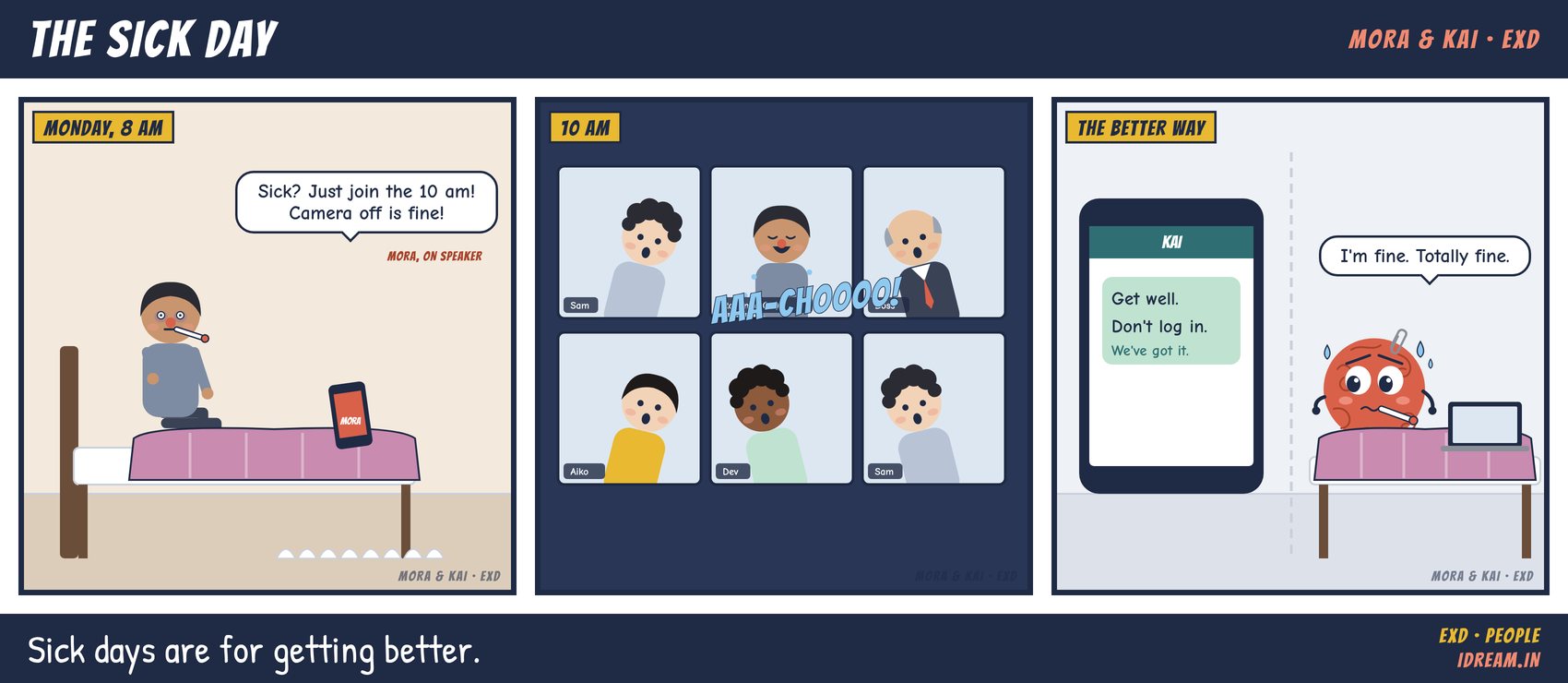
“Just join the 10 am! Camera off is fine!” Raj had called in sick, so he joined from bed, wrapped in a blanket. His mic was on when he sneezed, and twelve people heard it.
Outside the cartoon, the request is usually gentler. “Only if you’re up to it.” “Just keep an eye on email.” “Could you send that file before you rest?” Each one sounds reasonable. Together they tell people that a sick day is a work-from-bed day, and most people get the message the first time.
Why it happens
Managers rarely set out to make sick people work. What they are reacting to is a gap. When someone drops out without warning, the work they carry has nowhere else to go, so the manager reaches for the one person who knows it, even though that person is ill. The request is really a confession: this team has no cover.
Habit does the rest. If the boss logs in with a fever, everyone below learns that’s what commitment looks like. Over time, “camera off is fine” stops sounding like a kindness and starts sounding like the minimum.
What it really costs
People who work while ill recover more slowly and do worse work. Both effects are easy to see on any team.
Take an illustrative case. Someone with a bad cold would usually be back to full strength after two days of proper rest. Instead, they log in from bed, stay half-unwell, and drag at half speed for, say, a week. Rough maths: two days lost becomes the equivalent of two and a half days lost, plus whatever errors slipped into the work done with a temperature. The organisation paid more to get less.
Then comes the worst habit of all. People who feel they can’t truly be off sick start coming in sick instead, because at least then they’re seen to be working. One sneeze in a meeting room can turn one sick day into five, across five different people.
The last cost is trust, and it is the hardest to win back. Telling someone to get well while handing them a meeting link is a mixed message, and people believe the meeting link.
What to do instead
- Make “I’m not well” a one-line message. No call, no justification, no list of pending work attached. A short text to the manager should be enough, and the manager’s reply should be just as short: “Get well. Don’t log in. We’ve got it.” That is Kai’s message, and it works because nothing else is asked for.
- Build cover into normal weeks, not emergencies. For each person, name a buddy who knows their live work well enough to keep it moving for two days. Have buddies sit in on each other’s key client calls now and then. Keep shared files in shared places, not personal drives. Cover is cheap to build on a quiet Tuesday and impossible to build on the morning someone wakes up with a fever.
- Have leaders go fully offline when they are ill. Out-of-office on, phone off, a named deputy in charge. Nothing a manager says about sick leave will carry as much weight as watching the boss actually take one.
A useful side effect: a team that can cover two days of illness can also cover a holiday or a sudden resignation with far less disruption. The investment pays back well beyond sick days.
Through the EXD lens
This sits in the People dimension of the EXD Framework: how the organisation looks after the people doing the work, and how teams are set up to support one another. Asking regularly whether people feel able to be properly ill, and whether their team could cover them, gives leaders an early signal of strain long before it shows up in attrition or burnout.
Try this tomorrow: go through your team and name who would cover each person for two days, starting tomorrow morning.
Mora & Kai is a cartoon series from iDream about the small frictions that make work harder. Each strip maps to one of the five dimensions of the EXD Framework: People, Process, Place, Technology and Culture.
Where is friction building up in your organisation? An EXD Audit finds it and puts a cost on it. Or bring your leadership team to the next IIT Hyderabad executive programme on employee experience.