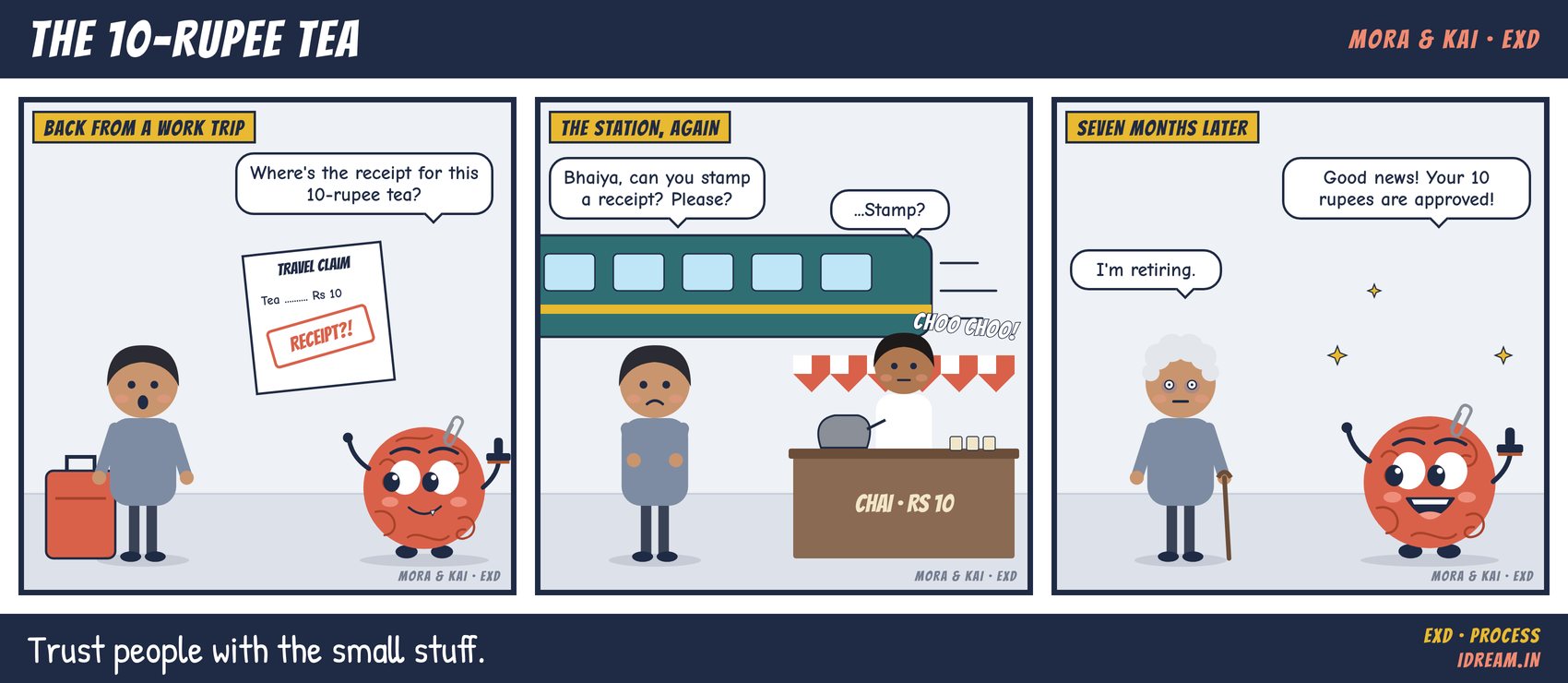
Ten rupees. That was the tea Raj drank on a work trip, and that was the claim Mora would not approve without a receipt. Seven months of emails later, the claim went through. By then Raj’s hair had turned white.
Few expense systems are quite that slow, but almost every organisation has a version of this. A modest taxi fare sent back for a missing signature. A ₹200 lunch that needs two approvals. An employee who simply stops claiming small amounts because the effort isn’t worth it, and quietly files the experience under “how this place sees me”.
Why it happens
Controls are designed around the risk of the large claim and then applied to every claim. Nobody sets out to spend ₹250 checking a ₹10 tea. It happens because the process has one route, built for the hotel bill and the client dinner, and everything travels down it.
The second reason is accounting. The money in a claim is visible: it shows up as a line in the books. The cost of processing it is invisible, spread across the employee’s time, a manager’s inbox and a finance team’s queue. So the organisation guards the number it can see and ignores the bigger one it can’t.
What it really costs
Here is some rough maths, purely illustrative. Say a small claim takes the employee 10 minutes to find and attach the receipt, a manager 5 minutes to approve, and someone in finance 10 minutes to check and query. Call it 25 minutes in total. At a blended staff cost of, say, ₹600 an hour, that is about ₹250 of time to process a ₹10 tea.
Now say the organisation handles 2,000 such small claims a year. The checking alone costs around ₹5 lakh, to protect a total value that might be a fraction of that. And that is before any chasing, any resubmissions, or seven months of follow-up emails.
The bigger loss is goodwill. A person trusted to manage a client relationship worth crores is told, in effect, that they can’t be trusted with ten rupees. They notice. Some respond by padding claims “to make it worth the hassle”. Others stop going the extra mile. Neither shows up in the expense report.
What to do instead
- Cost one claim, end to end. Pick your smallest common claim type and time every step, across every person who touches it. Put the figure next to the average claim value. The comparison usually settles the argument in the room.
- Set a trust limit. Below an agreed amount, pay claims on a simple declaration, without receipts or manager approval. Pick the level by looking at your own claim data, not a round number someone liked.
- Spot-check instead of checking everything. Review a small random sample of trusted claims each month, and act firmly on any misuse you find. The occasional abuse will cost far less than checking every claim, and a visible spot check keeps most people honest.
- Apply the same test elsewhere. Stationery requests, software under a set price, minor travel changes, meeting room bookings. Any approval where the checking costs more than the thing being checked is a candidate for the same treatment.
Finance teams are often the first to welcome this. Few of them joined the profession to query tea receipts, and the hours they get back can go into the large claims that genuinely deserve a careful look. Write the new limit down, tell everyone what it is, and review it once a year.
Through the EXD lens
This sits in the Process dimension of the EXD Framework: the everyday routines that either help people do their work or get in the way of it. Small approvals are easy to overlook because each one seems trivial. Measured regularly, they add up to a clear picture of where the organisation spends effort guarding small sums, which is often one of the first things an EXD Audit surfaces.
Try this tomorrow: ask finance how much staff time it takes to process your smallest category of claim, and compare it with the average amount claimed.
Mora & Kai is a cartoon series from iDream about the small frictions that make work harder. Each strip maps to one of the five dimensions of the EXD Framework: People, Process, Place, Technology and Culture.
Where is friction building up in your organisation? An EXD Audit finds it and puts a cost on it. Or bring your leadership team to the next IIT Hyderabad executive programme on employee experience.