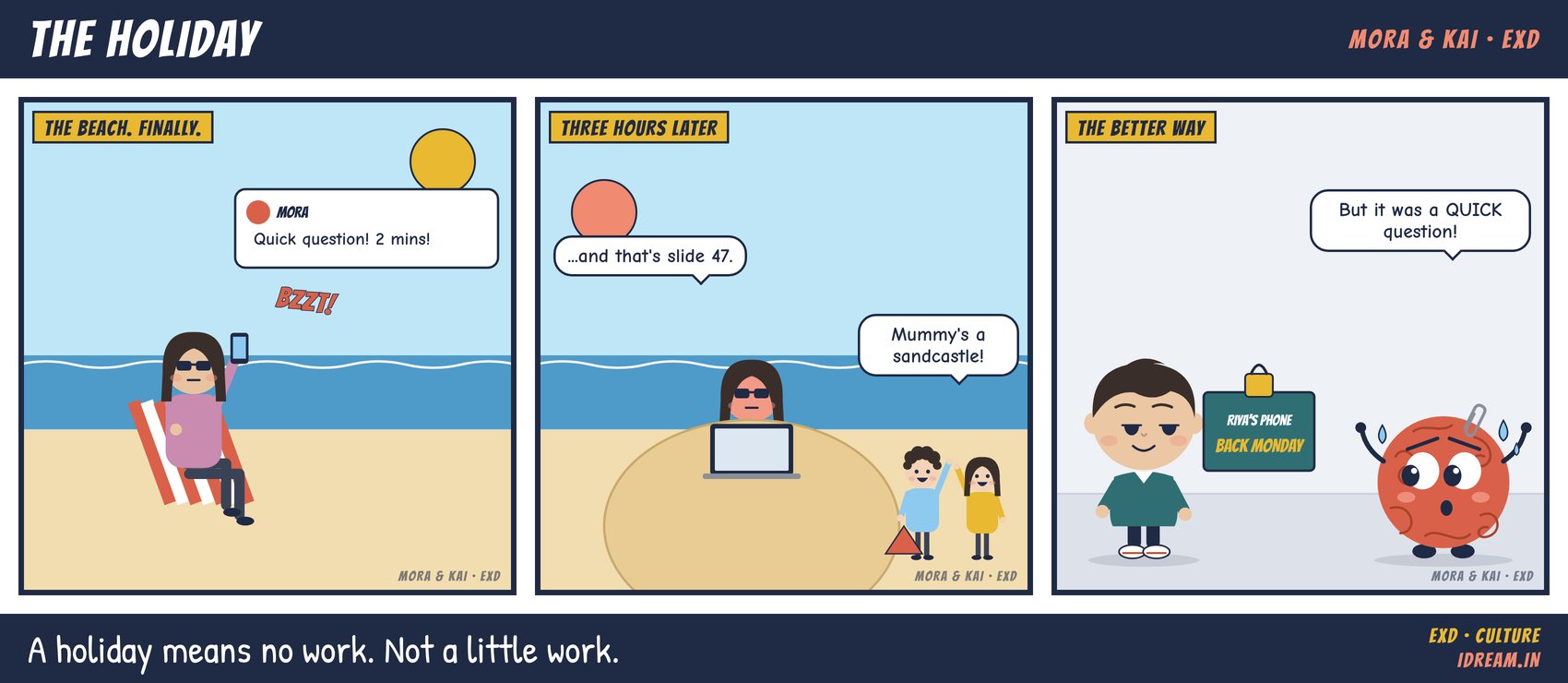
Riya finally made it to the beach. Then her phone lit up: “Quick question! 2 mins!” Three hours later she was buried up to her neck in sand, presenting slide 47 to a client.
The real-world version rarely involves sand, but it is just as familiar. Someone goes on leave, and within a day there is a “just checking” message, a document only they can find, a call only they can explain. They answer, because it feels easier than coming back to a mess. The holiday continues on paper. In their head, it has ended.
Why it happens
The usual explanation is that people can’t switch off. That puts the problem in the wrong place. People keep working on holiday because the team has been built so that some things only they can do. Their knowledge lives in their inbox, their client relationships run through their phone, and nobody else has ever been asked to step in.
That arrangement is invisible on a normal day. It looks like efficiency: one person, one area, no overlap. Leave is simply the moment it shows. The “quick question” is a symptom of how the work is divided, and no amount of willpower on the beach can fix a structural gap back at the office.
What it really costs
Rest works only when the mind is genuinely off duty. A half-holiday, with the phone always within reach, keeps a part of the brain on watch the whole time. People come back as tired as they left, and sometimes more resentful.
Look at it as a business decision. Paid leave is already a cost the organisation carries. Say someone takes ten days off. If they spend those days half-working, the company has paid for ten days of rest and received almost none of the benefit: no fresh energy, no clearer thinking, nothing banked against the next busy quarter.
There is a risk cost too. If one three-hour call on a beach was the only way to save a client meeting, the organisation has a single point of failure. Holidays reveal it politely. A resignation, or a medical emergency, reveals it far less politely.
What to do instead
- Plan cover a week before leave starts. Not on the last afternoon. Name a person for each live piece of work, and give them time to ask questions while the owner is still around.
- Write a one-page handover. Open items, key contacts, where the files live, what is likely to come up. If it doesn’t fit on a page, the work is too concentrated in one person.
- Agree what counts as an emergency, as a team. Be specific. “The client’s system is down” might qualify. “The client wants an update” doesn’t. Write the list down so nobody has to judge it under pressure.
- Give the emergency one route. The person on leave nominates one contact who is allowed to reach them, by phone, for items on the list. Everyone else goes through that contact.
- Debrief when they return. Ask the people who covered what they had to figure out. That list tells you where knowledge is stuck in one head, and what to share before the next holiday.
That last step is where the hidden benefit lies. A team that covers properly for one person’s leave learns how the work really runs. Juniors get stretched. Undocumented habits get written down. The team becomes less fragile, which is worth far more than a slide deck presented from a beach.
Through the EXD lens
In the EXD Framework this falls under Culture: what the organisation actually expects from people, as opposed to what the leave policy says. A policy can grant 20 days. Only the culture decides whether those days are rest. Asking people each quarter whether they were able to switch off completely on their last break shows whether that culture is improving or drifting.
Try this tomorrow: pick the next person on your team going on leave, and agree with them who covers what and what genuinely counts as an emergency.
Mora & Kai is a cartoon series from iDream about the small frictions that make work harder. Each strip maps to one of the five dimensions of the EXD Framework: People, Process, Place, Technology and Culture.
Where is friction building up in your organisation? An EXD Audit finds it and puts a cost on it. Or bring your leadership team to the next IIT Hyderabad executive programme on employee experience.