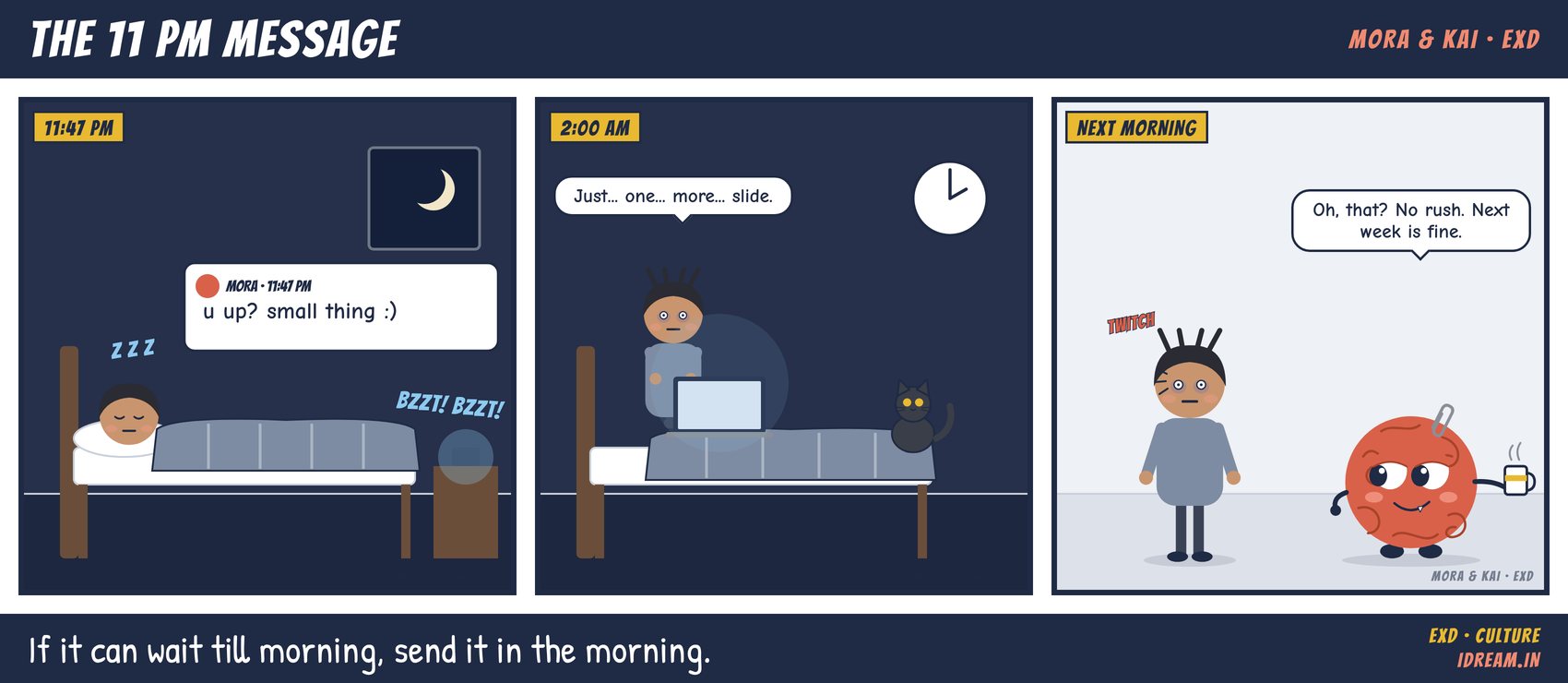
11:47 pm. “u up? small thing.” At 2 am Raj is still working on it. Next morning the reply arrives: “Oh, that? No rush. Next week is fine.”
Anyone who has managed people has probably sent that message. You were clearing your head before bed, you remembered something, and you typed it before you forgot. It felt considerate. You even called it small. On the other end, someone put down their dinner, or their child, or their sleep.
Why it happens
The sender and the receiver are reading two different messages. The sender means “whenever”. The receiver sees the time stamp, sees the name, and hears “now”. Rank does the translating. A note from a peer at midnight is a nuisance. The same note from the boss is an instruction, whatever the words say.
There is a second mechanism, and it is the one leaders tend to miss. Late messages teach. Each one tells the team, quietly, what hours they are expected to keep. Nobody ever announces a rule that people should be reachable at midnight. It forms on its own, one “small thing” at a time, until checking the phone before sleep becomes part of the job description. By then the sender has usually forgotten sending anything at all.
What it really costs
The obvious cost is a lost night, and the next day’s work pays for it. Tired people make slower decisions and more mistakes, and they are short with colleagues and customers.
The less obvious cost is attention. Here is an illustrative case. A manager sends three late messages a week into a team chat of eight people. Say each one costs each reader 20 minutes of reading, worrying and replying “on it”. That is eight hours of the team’s evening attention every week, spent on things that, by the sender’s own account, could wait. Over a quarter, the rough maths gets you to around 100 hours.
Then there is trust. When “urgent” and “whenever” arrive looking identical, people stop being able to tell them apart. So they treat everything as urgent, or worse, they start ignoring the evening messages that genuinely matter.
What to do instead
- Use scheduled send. Almost every email and chat tool has it. Write the message at 11:47 pm if that is when the thought arrives, and set it to land at 9:30 am. You get it off your mind; they get their night back.
- Agree a shared “not urgent” label, and use it every time. Something as plain as starting the message with “FYI, for next week” works, as long as the whole team uses the same words and trusts them. A label that only some people use is just noise.
- Keep one clear lane for real emergencies. Some late messages are genuinely needed: a client outage, a safety issue, a deal closing in another time zone. Agree what counts, and use a separate channel for it, such as a phone call. If it is worth waking someone for, it is worth a call. If it isn’t worth a call, it can wait until morning.
The habit that matters most, though, belongs to the person at the top. If the most senior person in the team sends at midnight, no label will fully undo the signal. If they visibly schedule their own messages, the rest of the team will copy them within weeks, and nobody has to write a policy.
Through the EXD lens
This is a Culture issue in the EXD Framework: the unwritten rules people learn from what leaders do, rather than from what the handbook says. Culture shifts slowly and is easy to misread from the top. Asking the team regularly whether they feel able to switch off in the evening, and tracking how that answer moves each quarter, tells you far more than any stated policy on working hours.
Try this tomorrow: check when your last ten messages to your team were sent, and count how many arrived after 9 pm.
Mora & Kai is a cartoon series from iDream about the small frictions that make work harder. Each strip maps to one of the five dimensions of the EXD Framework: People, Process, Place, Technology and Culture.
Where is friction building up in your organisation? An EXD Audit finds it and puts a cost on it. Or bring your leadership team to the next IIT Hyderabad executive programme on employee experience.