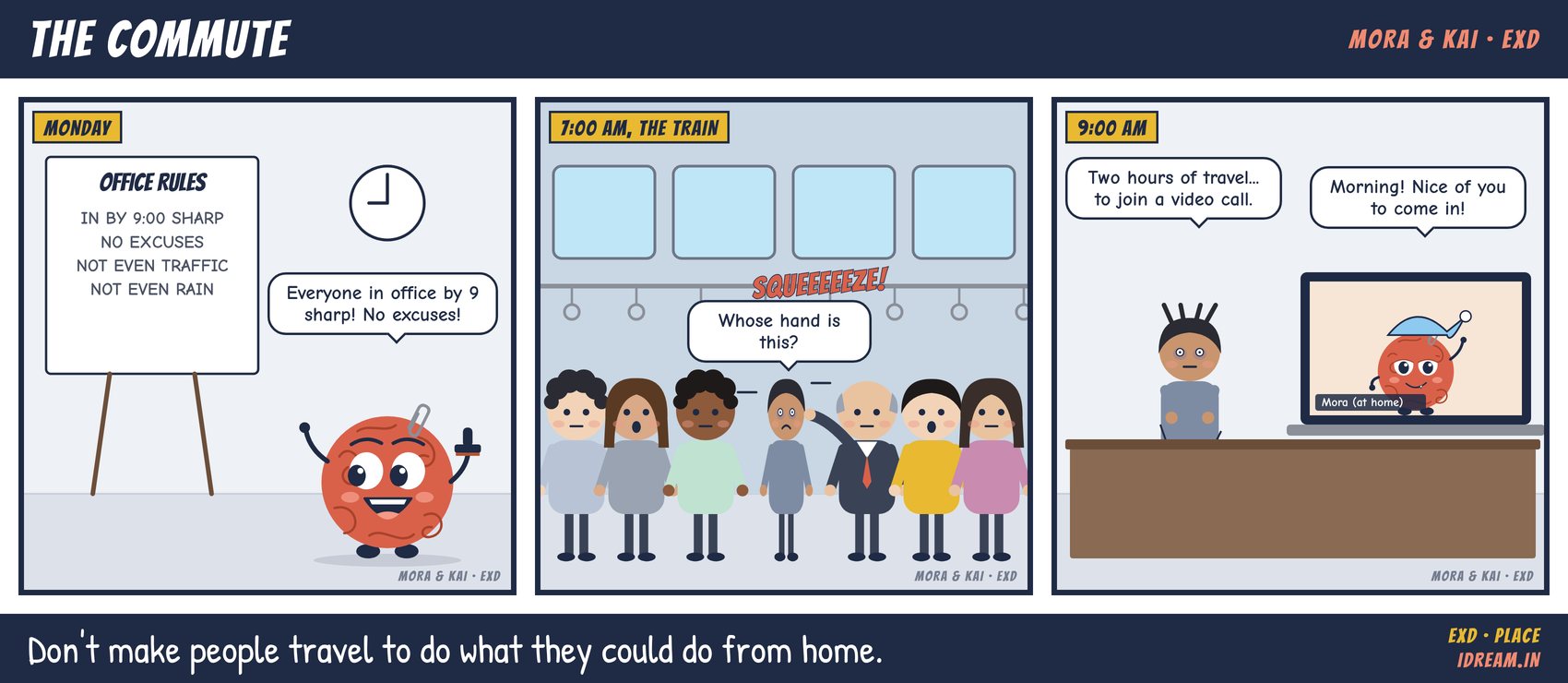
“Everyone in office by 9. No excuses.” Raj obeyed. He spent two hours squashed on a train and arrived just in time to join a video call. Mora, who wrote the rule, joined the same call from home.
Most leaders will recognise a milder version. A team is told to come in on set days. People make the journey, put on headphones and spend the day on calls with colleagues in other cities. By evening they have given up three or four hours of their own time to do exactly what they could have done at the dining table.
Why it happens
Attendance is easy to count. The value of a day together is not. So policies get written in the one unit that is simple to track, which is days in the building, while the real benefit of being together sits somewhere else entirely: in particular conversations, workshops and moments that happen only when the right people share a room.
Two more things make it worse. Calendars still carry the habits of the remote years, so every meeting gets a video link by default, even when everyone is on the same floor. And the people who write attendance rules rarely feel them the way others do. A senior leader with a driver, or a flat ten minutes away, experiences “three days a week” very differently from someone changing trains twice at 7:40 am.
What it really costs
Take a team of ten with a commute of 90 minutes each way. That is three hours a day per person. Over three office days a week, the rough maths comes to 90 hours of the team’s time on the road every week. That is more than two full working weeks, given up unpaid, before a single useful thing has happened.
If half of those office days are spent on calls that were online anyway, half of that journey bought nothing. Then add what doesn’t show up in any spreadsheet. People arrive tired and leave early to beat the traffic. And when they notice that the rule’s author stayed home, the policy stops looking like a business decision and starts looking like control. That is the point where trust quietly drains away.
What to do instead
- Sort the work with the team. Draw two columns. In one, the work that is genuinely better together: onboarding new joiners, planning, difficult conversations, solving a knotty problem at a whiteboard. In the other, work that is fine apart, such as focused writing, routine status updates and calls with people who are remote anyway. Most teams agree on the columns within half an hour.
- Anchor office days to the first column. Pick team days when the together work lands, and get the whole team in on the same days. Otherwise people commute to sit next to strangers and message their own colleagues.
- Protect the office day from the calendar. Move recurring video calls and status updates to home days. On anchor days, book rooms for working sessions, not for people to take calls in.
- Ask, don’t just count. Badge swipes tell you who came in. They don’t tell you whether it was worth it. After each office day, ask one question: “Was today worth the journey?” Track the answers by team, and adjust. Leaders should also turn up on the days they ask others to.
None of this needs a new policy document. It needs a team conversation and a cleaner calendar.
Through the EXD lens
This strip sits in the Place dimension of the EXD Framework. Place covers more than the building: it includes the journey to it and whether the space actually suits the work people come in to do. Measuring it regularly, for example through the Place questions in a quarterly EXD Score, shows whether office days are getting more useful over time or simply getting longer.
Try this tomorrow: look at last week’s office days and count how many hours your team spent in meetings that were online anyway.
Mora & Kai is a cartoon series from iDream about the small frictions that make work harder. Each strip maps to one of the five dimensions of the EXD Framework: People, Process, Place, Technology and Culture.
Where is friction building up in your organisation? An EXD Audit finds it and puts a cost on it. Or bring your leadership team to the next IIT Hyderabad executive programme on employee experience.