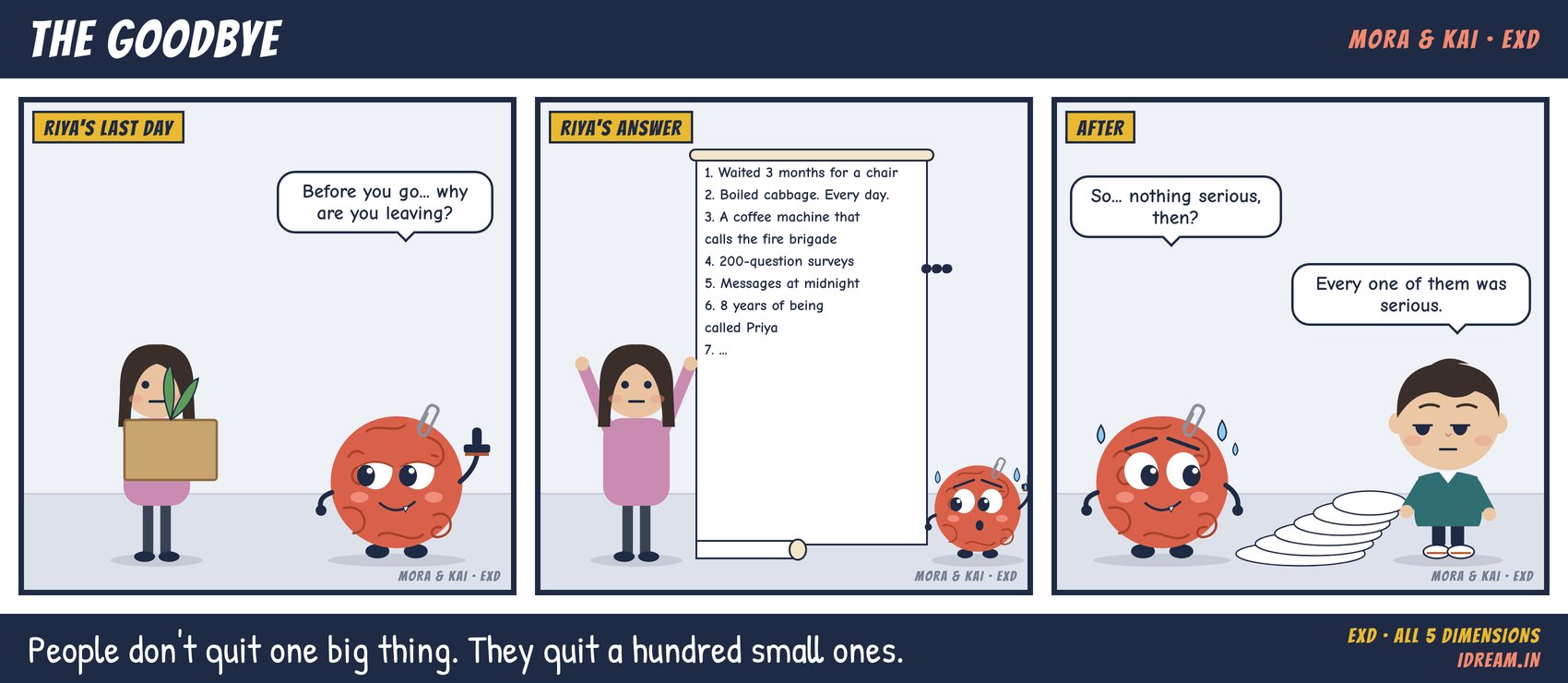
Riya was leaving after eight years. Asked why, she unrolled a scroll that reached the floor: the broken chair, the cabbage in the shared fridge, the midnight messages, eight years of being called Priya.
Real exit interviews go differently. The leaver says “a better opportunity” or “career growth”. Someone records it in a spreadsheet, and everyone moves on. The scroll never leaves the drawer.
Why it happens
Exit interviews look for one reason, and people offer the polite one. By then the leaver has nothing to gain from honesty and a reference to protect. So the organisation hears about the offer letter, which was the last straw, and never about the haystack underneath it.
Timing makes it worse. An exit interview happens after the decision, when nothing can be changed for that person. Even a perfectly honest answer arrives too late to be useful to them.
The haystack builds because each friction looks too small to raise. Mentioning the chair feels petty. Complaining about late-night messages feels like a lack of commitment. And each item belongs to a different owner. Facilities owns the chair. IT owns the slow laptop. The manager owns the messages. Nobody owns the total, so nobody sees it grow.
Riya’s scroll is a neat illustration of the five dimensions of the EXD Framework. Being called by the wrong name for eight years is a People problem. The chair and the fridge are Place. A clunky expense system would be Process, a laptop that takes ten minutes to boot would be Technology, and messages at midnight are Culture. None of them would make anyone resign alone. Added up across all five, over years, they make leaving feel like relief.
What it really costs
Rough maths for one experienced person on a salary of, say, ₹18 lakh. A recruiter fee of perhaps ₹2 lakh. Then three months for the replacement to get up to speed, at roughly half output: about ₹2.25 lakh of salary paid for work not yet done. Over ₹4 lakh before you count the eight years of knowledge, relationships and judgement that walked out with Riya.
Set that against the scroll. A decent chair costs a few thousand rupees. A fridge rule costs nothing. Learning someone’s name costs nothing at all.
The people you lose this way are often the ones you most wanted to keep. Long-serving staff carry the unwritten knowledge of how things actually get done. They also tolerate friction longest, out of loyalty, which means that by the time they leave, the pile is very high indeed. Their departure is a late signal, and an expensive one.
What to do instead
- Measure friction regularly, across all five dimensions. One-off listening catches only what is loud. A short, regular check, such as taking the EXD Score each quarter, shows small frictions as they pile up, by team and by dimension, while there is still time to act.
- Hold stay conversations. Sit down with people who have been with you a long time and ask one question: “What one small thing would you fix tomorrow?” Long-serving people know exactly where the frictions are, and they are rarely asked. Fix what you can within a fortnight and say so.
- Review the total, not the items. Once a quarter, put every small complaint for a team on one page, whoever owns them. A list of fifteen minor items reads very differently from fifteen separate tickets.
One caution. Do not turn stay conversations into a form. The value is in the conversation, the follow-up and the visible fix. A twenty-field “retention questionnaire” would simply add one more item to the scroll.
Through the EXD lens
This strip covers all five dimensions because resignations usually do. People, Process, Place, Technology and Culture are separate lenses on the same working day, and friction in one is often tolerated only until it meets friction in another. Measuring all five together, regularly, is how you see the scroll while it is still short.
Try this tomorrow: ask someone who has been with you for years what one small thing they would fix, and fix it this week.
Mora & Kai is a cartoon series from iDream about the small frictions that make work harder. Each strip maps to one of the five dimensions of the EXD Framework: People, Process, Place, Technology and Culture.
Where is friction building up in your organisation? An EXD Audit finds it and puts a cost on it. Or bring your leadership team to the next IIT Hyderabad executive programme on employee experience.