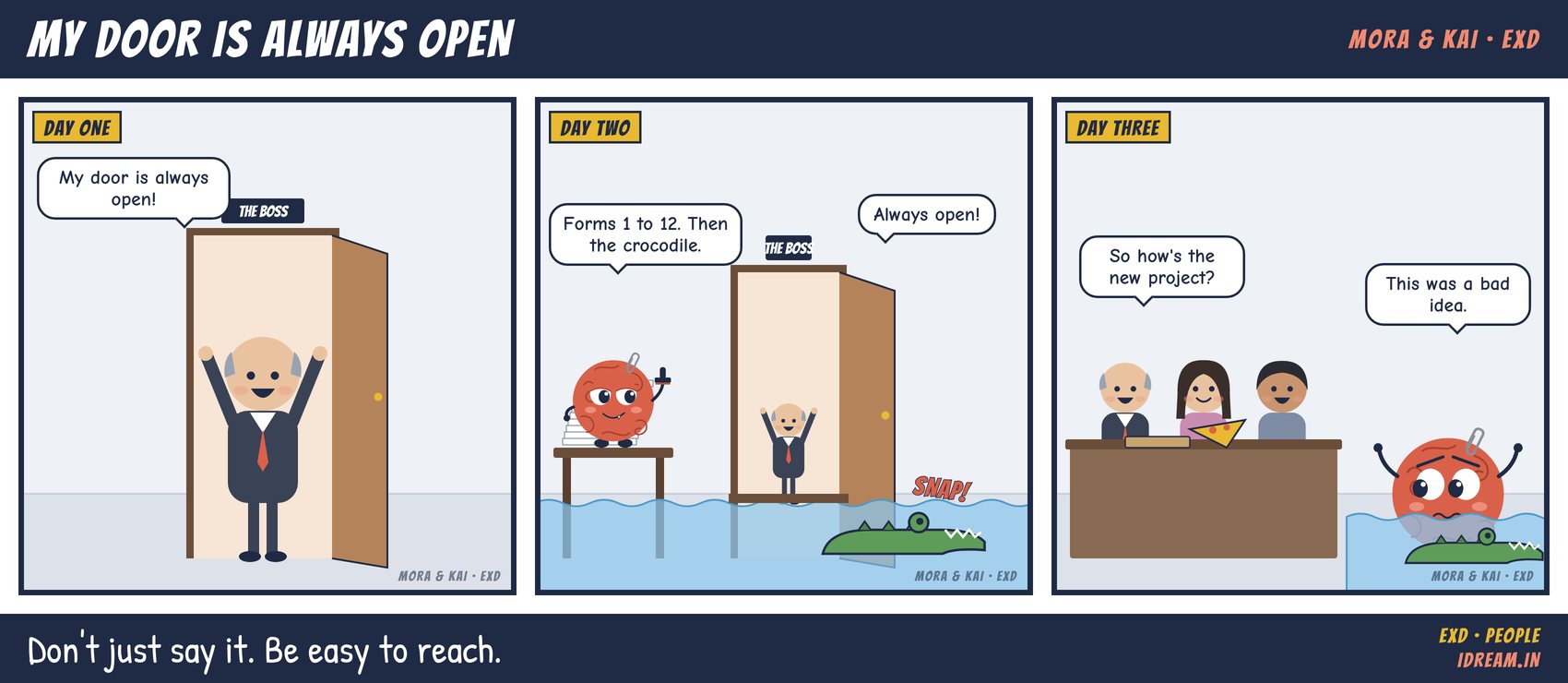
“My door is always open!” said the Boss. Between his door and the corridor stood twelve forms, a moat and a crocodile. Kai skipped the door entirely and took the team out to lunch.
Most leaders who say this mean it. They would genuinely welcome a knock. And most would be surprised to learn how rarely anyone below them seriously considers knocking.
Why it happens
Nobody decides to become unreachable. It builds up. An assistant protects the calendar, as they should. The calendar fills with back-to-back blocks from nine to seven. A floor move puts the leadership team behind a glass wall and a security card. Each change is sensible on its own.
Then there is the part no one designs: fear. Walking into a senior leader’s room uninvited feels like a risk to a junior person. Will I look foolish? Is this important enough? Will my manager mind that I skipped them?
An open door puts the whole burden on the person with less power. They have to find the time, judge the moment and take the risk. Most won’t, unless the problem is already serious. That is the hidden cause: an open door is a passive invitation, and passive invitations mostly reach the confident and the already close.
What it really costs
The cost is information, and timing. Leaders who are hard to reach hear about problems last, usually when they have become expensive.
Take an illustrative case. In week two of a project, a team member notices a supplier will miss a deadline. Raised then, it costs one phone call. Heard in week ten, after travelling up through two layers of management and being softened at each step, it costs a delay penalty, a weekend of rework and an awkward client call. Nobody hid anything. The news simply took the long route because the short one felt closed.
There is also the cost of who you don’t hear from. If only the confident walk in, your picture of the organisation is drawn by its most confident people.
Over time, the gap shapes decisions. Strategy gets set on a filtered view, and the people closest to customers and suppliers learn that their knowledge does not travel upward. Some of them stop trying. A few take what they know to a competitor who listens.
What to do instead
Go to them. The leaders people really talk to don’t wait at the door. They have lunch in the canteen, walk the floor without an agenda and sit in on a team stand-up now and then. A conversation in someone else’s space carries far less risk for them.
Ask a specific question. “Any issues?” invites “No, all good.” Try “What’s one thing slowing you down this week?” A specific question gives people permission to answer honestly.
Protect empty time. Block two hours a week with no meetings, and tell your assistant that anyone who asks for that time gets it, no reason needed.
Close the loop in public. When a corridor conversation leads to a change, say where the idea came from. Nothing invites the next conversation faster.
Measure it. Once a month, look back at your diary and count the conversations other people started, and who started them. If the same five names keep appearing, widen the circle. Make a point of reaching the teams you have not heard from, and notice who still never comes to you. That list tells you where the moat is deepest.
Through the EXD lens
Reachable leadership sits in the People dimension of the EXD Framework: the relationships that decide whether bad news travels fast or slow. It is easy to believe you are approachable and hard to check from your own chair. Asking the People questions in the EXD Score each quarter gives you an outside read on whether employees feel able to raise concerns, and whether the lunches and floor walks are working.
Try this tomorrow: count the conversations you had last week that someone else started, because that number is your real open door.
Mora & Kai is a cartoon series from iDream about the small frictions that make work harder. Each strip maps to one of the five dimensions of the EXD Framework: People, Process, Place, Technology and Culture.
Where is friction building up in your organisation? An EXD Audit finds it and puts a cost on it. Or bring your leadership team to the next IIT Hyderabad executive programme on employee experience.