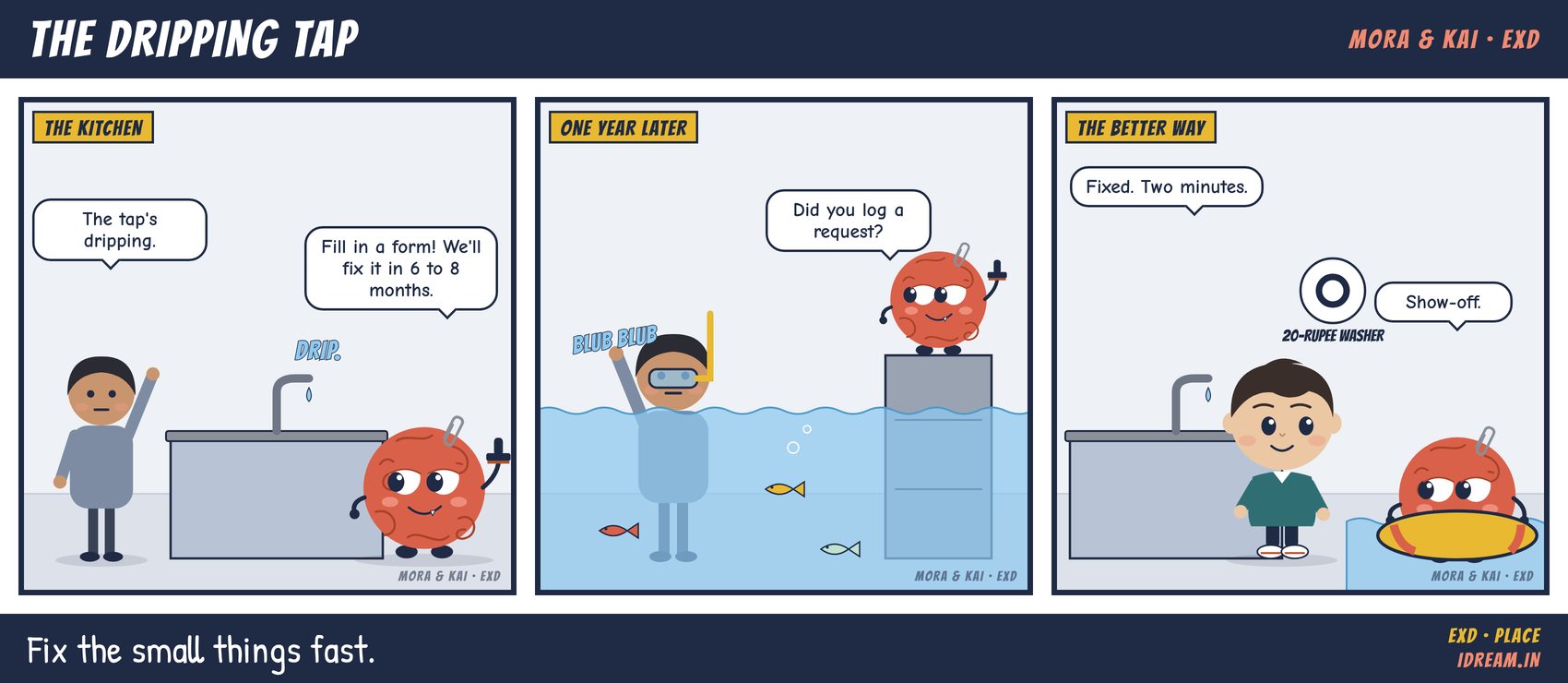
Twenty rupees. That was the price of the washer Kai used to fix the kitchen tap, the one Mora’s form had scheduled for repair “in 6 to 8 months”. A year on, people were reaching the kettle in snorkels.
Every office has its dripping tap. The meeting room screen that needs three attempts to connect. The washroom lock that sticks. The chair with a wheel missing, pushed into a corner where it has lived since last Diwali. Each is small. Together they describe a workplace more honestly than the brochure does.
Why it happens
Small repairs fall through the gaps in how facilities are run. Big projects have budgets, owners and approval routes. Small repairs are often pushed through the same approval route, which was designed for large spend. A ₹200 job waits in the same queue as a ₹20 lakh one, behind the same signatures.
Nobody owns the small stuff, so each item waits for someone senior to notice. People with that authority rarely use the third-floor kitchen.
There is a habit problem too. When a fault has been around long enough, people stop seeing it. The sticky lock becomes “just how that door is”. New joiners notice for a week, then learn to jiggle the handle like everyone else.
Meanwhile, everyone else reads the broken tap as a message. Nobody here notices, and if they notice, they don’t care. That message does not stay in the kitchen. If the organisation can’t fix a tap in a year, people quietly lower their hopes about the things that matter more: their workload, their tools, their manager.
What it really costs
An illustrative example. A meeting room screen that wastes ten minutes per meeting, six meetings a day, 22 working days a month, is 22 hours of lost meeting time. With five people in the average meeting, that is 110 person-hours a month. At ₹1,500 an hour, about ₹1.65 lakh a month, every month, for a fault a technician could fix for a few thousand rupees.
Small problems also grow. A drip becomes a stain, the stain becomes a damp wall, and the washer job becomes a flooring job. Then there is the cost you can’t invoice: people who stop reporting problems at all, because reporting never worked.
What to do instead
- Name one owner per floor or site. One person, not a ticketing system, who is answerable for small fixes.
- Give that person a fix-it-fast budget. Say ₹25,000 a month per floor, spendable without approval on any single repair under a set limit. The limit matters more than the total.
- Set a clock. Anything under the limit is fixed within five working days, or the owner explains why in writing.
- Keep the list visible. A whiteboard by the kitchen or a shared sheet everyone can see. Anyone can add an item. Only the owner can close one.
- Close it every Friday. Fifteen minutes: what got fixed, what is stuck and who is unblocking it. Then tell people what changed.
The visible list does more work than it seems. It shows that problems are heard, and it shows the fixes. Both are part of the point.
A word on the budget. Finance teams sometimes worry that money without approval will leak. In practice the limit per repair does the controlling, and a monthly look at what was spent catches anything odd. The approval queue it replaces usually costs more in time than the repairs themselves.
Through the EXD lens
This sits in the Place dimension of the EXD Framework. Big refurbishments get the attention, but people experience Place mostly through small, daily things that either work or don’t. A fit-out handover tells you how the space looked on day one. Asking the Place questions in the EXD Score every quarter tells you how it is holding up, and whether small fixes are actually happening.
Try this tomorrow: ask your team to list everything that has been broken for more than a month, and fix the cheapest item before Friday.
Mora & Kai is a cartoon series from iDream about the small frictions that make work harder. Each strip maps to one of the five dimensions of the EXD Framework: People, Process, Place, Technology and Culture.
Where is friction building up in your organisation? An EXD Audit finds it and puts a cost on it. Or bring your leadership team to the next IIT Hyderabad executive programme on employee experience.