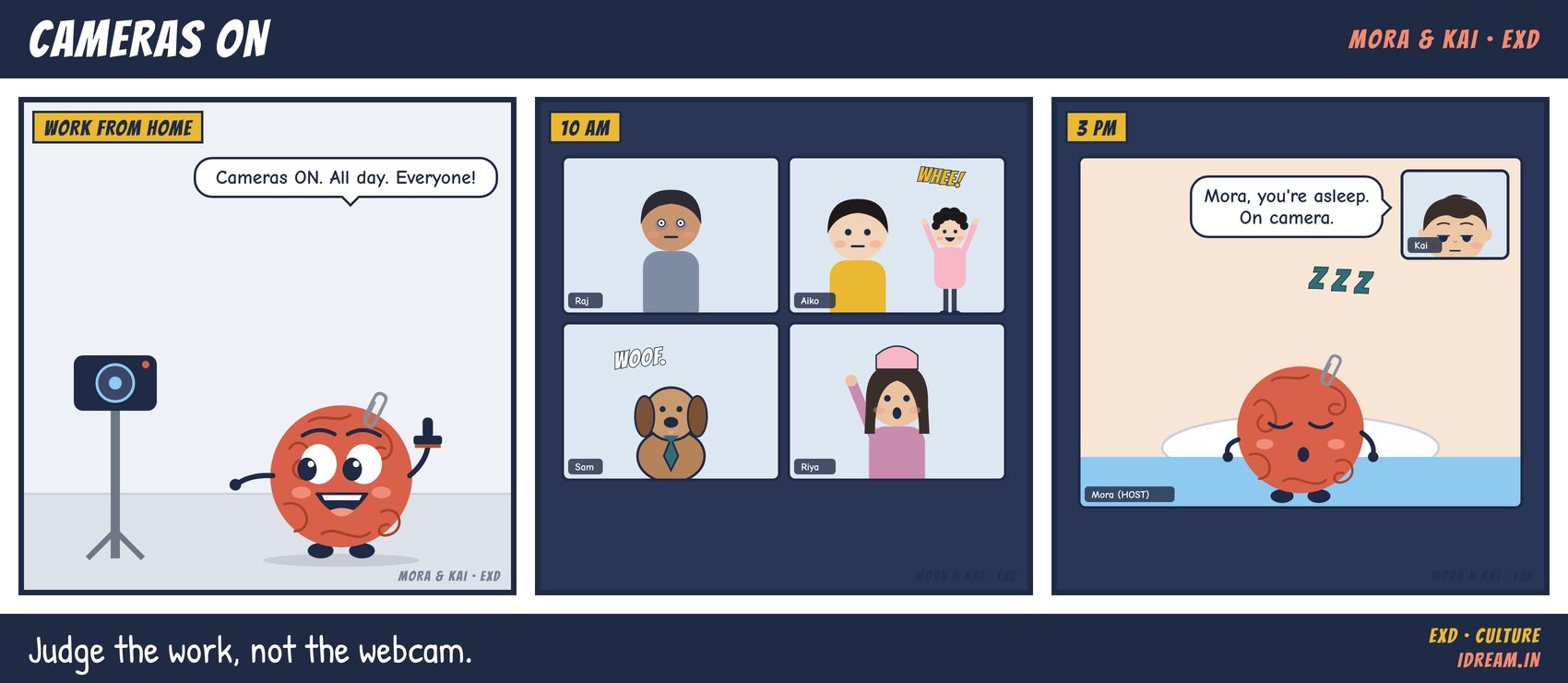
“Working from home? Cameras ON. All day.” That was Mora’s new rule. By 3 pm its author was fast asleep on screen, in full view of the team.
The joke lands because the rule is real. Plenty of managers, uneasy about work they can’t see, have tried to rebuild the office through a webcam. It feels like control. It rarely delivers any.
Why it happens
When work moved out of sight, many managers lost the only measure they had ever really used: presence. In an office, a person at their desk looked like evidence of effort. Cameras promise to bring that evidence back.
Presence was always a weak proxy. Someone can look busy for eight hours and produce little, or stare out of the window for an hour and solve the problem that mattered. All-day cameras measure the proxy more intensely and leave the real question untouched: is the work good? Underneath sits a simpler gap. Many teams never agreed what good output looks like. Without that agreement, watching is the only tool left in the box.
What it really costs
Being on camera is tiring. People hold their faces still, check their backgrounds and feel observed in their own homes. That attention has to come from somewhere, and it comes from the work.
It also lands unevenly. The person sharing a small flat with family, or working from a corner of the bedroom, pays far more for an all-day camera than the manager with a quiet study. A rule that looks equal on paper is not equal in practice.
Rough maths: say all-day cameras cost each person 30 minutes of focus a day through self-monitoring and broken concentration. For a team of 20, that is 10 hours a day, or about 50 hours a week. More than one full-time person’s output, gone, to produce a video feed nobody has time to watch.
The trust cost is larger. A camera rule tells capable adults they are suspected of slacking. Your best people, the ones with options, hear that message most clearly. Some of them will act on it, and they won’t mention the camera in the exit interview.
What to do instead
- Agree what good looks like, in writing. For each role, a few outcomes for the week or the month, with a shared sense of quality. Review those in your one-to-ones. Stop reviewing hours online.
- Sort meetings into two piles. Workshops, difficult conversations, a new joiner’s first week and a pitch rehearsal all gain from seeing faces. Status updates and large broadcast calls usually don’t. Ask the team to sort their regular meetings and keep cameras for the first pile only.
- Build connection on purpose. A weekly call with no agenda beyond catching up. A channel for small wins. A day each month together in person, planned around work that benefits from being in the same room. People feel connected through contact they choose.
None of this is softer than a camera rule. It is harder, because it asks managers to be clear about results. That clarity was the missing piece all along.
Start with your own calendar. If leaders keep cameras off in their own meetings while asking teams to stay visible, the rule will read as exactly what it is.
A useful check for any manager: if you could not see your team for a month, would you know whether the work was on track? If the honest answer is no, the camera was never the real tool. The fix is in how work is planned and reviewed, and it improves the office days too.
Through the EXD lens
In the EXD Framework this is a Culture question: what the organisation’s daily habits say about whether people are trusted. Culture is easy to describe in a values statement and hard to see in practice. Measuring it regularly, for instance through the Culture questions in the EXD Score each quarter, shows whether a rule like this one is quietly draining goodwill well before the resignations start.
Try this tomorrow: ask your team which of this week’s meetings truly needed cameras, and switch them off for the rest.
Mora & Kai is a cartoon series from iDream about the small frictions that make work harder. Each strip maps to one of the five dimensions of the EXD Framework: People, Process, Place, Technology and Culture.
Where is friction building up in your organisation? An EXD Audit finds it and puts a cost on it. Or bring your leadership team to the next IIT Hyderabad executive programme on employee experience.