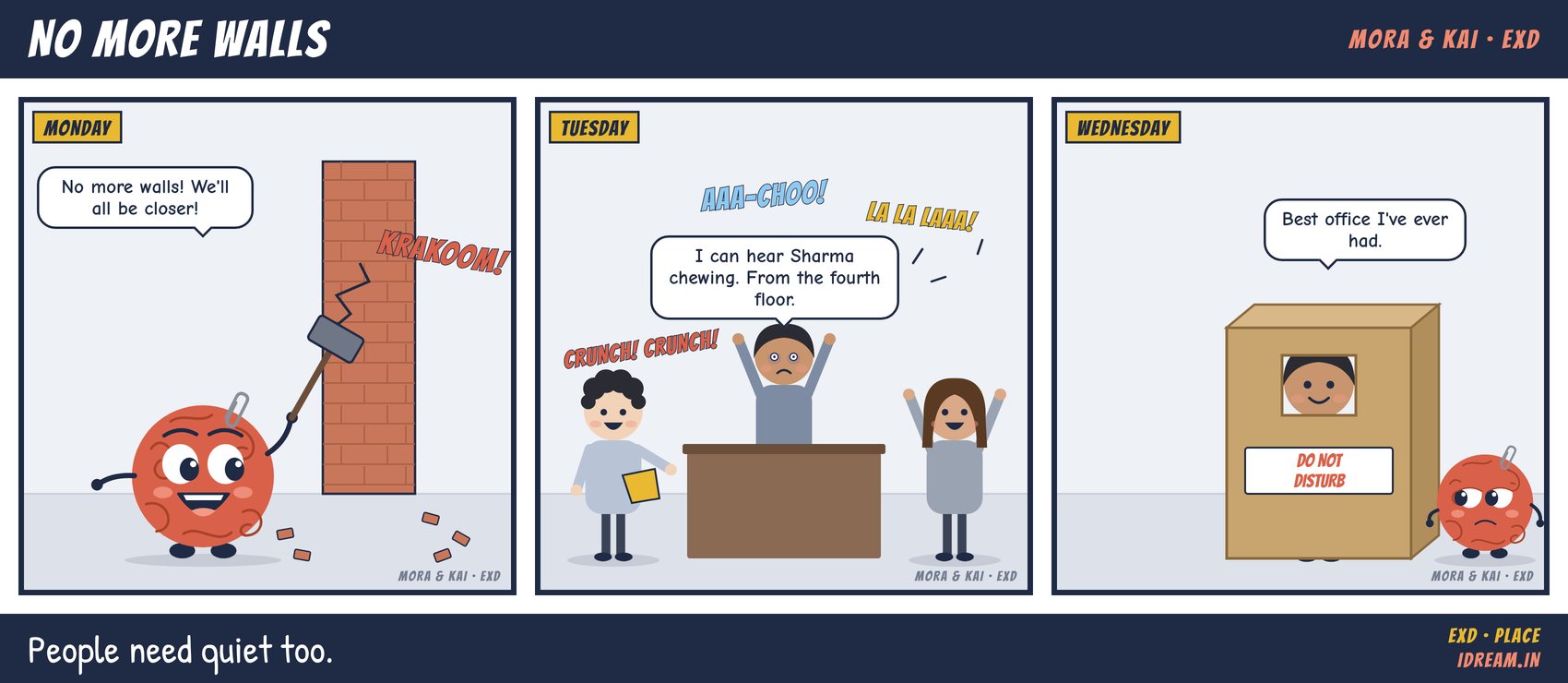
Raj lasted until Wednesday. The walls came down, Mora promised everyone would be closer, and by midweek he had built himself a cardboard box with a slot cut out for his eyes.
Most offices have a Raj. Sometimes it is the analyst wearing noise-cancelling headphones by 10 am. Sometimes it is the manager who books a six-seat meeting room every afternoon and sits in it alone. Neither is being antisocial. They are trying to get their work done in a building designed for a different kind of work.
Why it happens
Office decisions are usually framed as a single choice: open plan or cabins, collaboration or privacy. That framing assumes each person does one kind of work. They do not. In one morning, a product manager might take a client call, think through a pricing problem, chat with a colleague about a bug and then spend an hour writing. Each of those needs a different setting, and the switches happen within the hour.
The open office solves for one mode, interaction, and makes the others harder. The closed office solves for focus and starves interaction. Both fail for the same reason: they give one answer to a question that has several.
There is also a measurement trap. Interaction is visible. You can walk the floor and see people talking, and it feels like energy. Concentration is invisible, so nobody notices when it disappears.
What it really costs
Focused work is where most of the value in knowledge jobs gets made: the analysis, the code, the proposal that wins the deal. It is also fragile. An interruption costs more than its own few seconds, because getting back into a hard problem takes time.
Some illustrative arithmetic. Say an engineer loses 20 minutes of focus to noise and interruptions four times a day. That is over an hour daily, or close to a full day every week. Across a team of 30, it adds up to the output of about six people, paid for and never received.
The quieter cost is where the work goes. People begin to treat the office as a venue for meetings and save the real work for home. Leaders then wonder why the floor feels empty, and expensive real estate turns into a very expensive meeting venue.
What to do instead
First, look for the warning signs. Meeting rooms booked by one person. Headphones on most heads by mid-morning. Phone calls taken in stairwells. People saying “I’ll finish that at home tonight”. If you see two or more of these, your office is short of space for focus.
Before calling in the architects, try the small fixes:
- Declare a quiet zone. One clearly marked section of the floor, with simple rules: no calls, and conversations move elsewhere.
- Give calls a home. Phone booths or small call rooms remove the single biggest source of noise on an open floor.
- Stop solo bookings of large rooms and offer a few small bookable focus rooms instead.
- Agree team norms on interruptions. For example, headphones on means “not now”, or two protected focus blocks a day when chat can wait.
- Ask before you build. A short survey on where people go to concentrate, and what stops them, will tell you which of these fixes matters most on your floor.
None of these needs a renovation. Together they turn one kind of space into several, and they let people choose. Choice is the point: the same person needs a buzzing table at 10 am and a quiet corner at 2 pm.
Through the EXD lens
This is the Place dimension of the EXD Framework: whether the physical setting supports the work people actually do. The test is not how the office looks in the brochure but how well it supports both focus and conversation on an ordinary Tuesday. Checking that every quarter shows whether a fix like a quiet zone is being used, or politely ignored.
Try this tomorrow: ask five people where they go when they really need to concentrate, and count how many answers mean “not here”.
Mora & Kai is a cartoon series from iDream about the small frictions that make work harder. Each strip maps to one of the five dimensions of the EXD Framework: People, Process, Place, Technology and Culture.
Where is friction building up in your organisation? An EXD Audit finds it and puts a cost on it. Or bring your leadership team to the next IIT Hyderabad executive programme on employee experience.