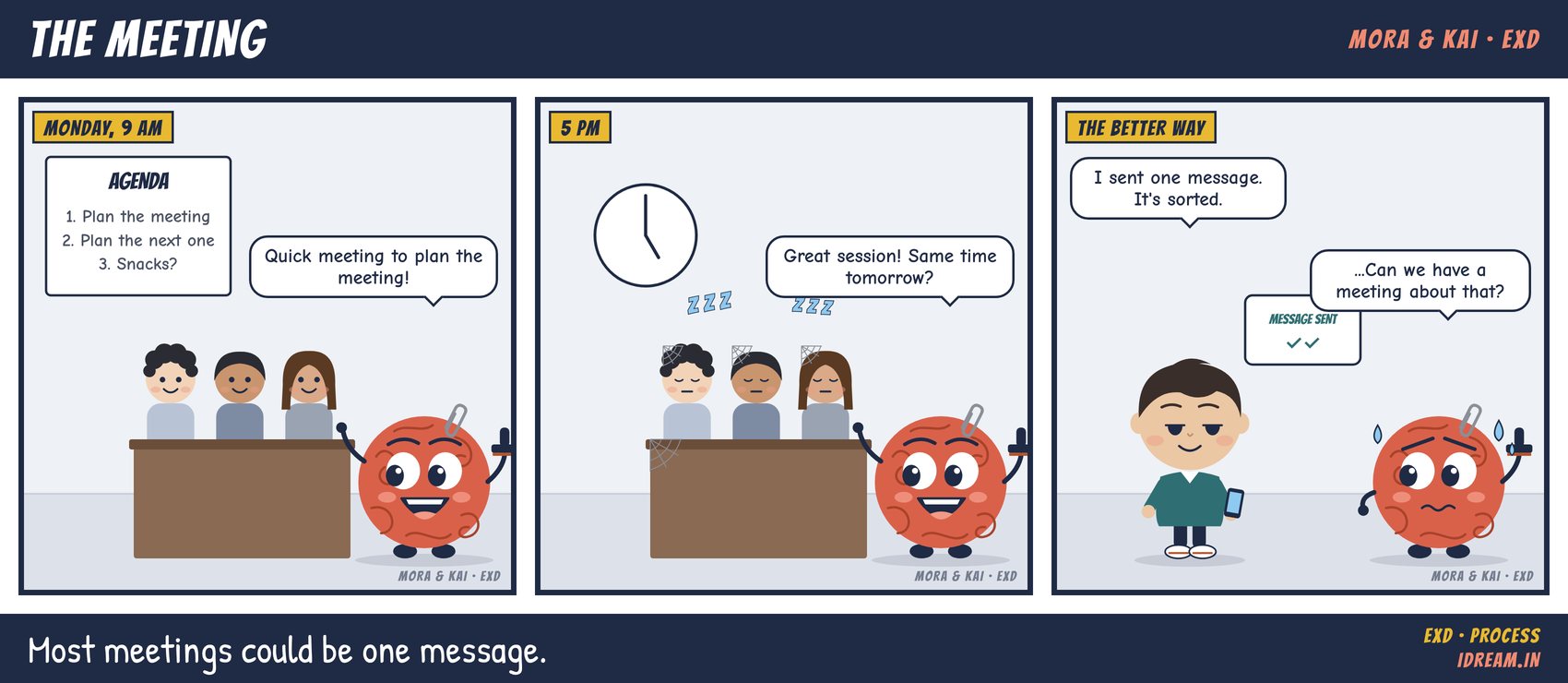
In this week’s strip, Mora calls a meeting to plan a meeting, then books a follow-up to review how the first one went. Kai sends one message, and the whole thing is sorted before lunch.
You have sat in that room. Twelve people, one shared screen, a deck nobody asked for, and a closing line that says “let’s take this offline”. Everyone leaves an hour older. The only thing that has changed is the date of the next meeting.
Why it happens
Meetings are the only workplace expense that never arrives with an invoice. A manager who wants a ₹40,000 laptop needs an approval. The same manager can spend far more than that on a recurring Monday review without asking anyone, because the cost is paid in other people’s hours and never shows up on a budget line.
There is a second force at work. A meeting looks like progress. It produces attendance, slides and minutes, all of which can be shown to someone senior. A short written update produces none of that visible activity, even when it does the job better. So the meeting wins by default.
And once a meeting becomes recurring, it rarely dies. Nobody wants to be the person who cancelled the leadership sync. It outlives the project it was created for, and new people join because they were invited, not because they are needed.
What it really costs
Take one weekly status meeting and do some rough maths. Say eight people attend for an hour, at an illustrative loaded cost of ₹2,000 an hour per person.
- One meeting: 8 hours of working time, about ₹16,000.
- Over a year of 48 working weeks: 384 hours, about ₹7.7 lakh.
That is a single meeting. Most leaders have a dozen like it on their calendars, and the senior ones are the most expensive hours in the building.
The bigger cost does not appear in the sum. An hour dropped into the middle of the morning breaks the day into pieces too small for real work, so the people who build, write and analyse lose more than the hour itself. And when meetings become the place where updates happen, people stop reading updates anywhere else. That creates the need for more meetings, and the cycle feeds itself.
What to do instead
Start with one question for every meeting on the calendar: does this exist to decide something, or only to inform people? Informing can be written down. Deciding usually needs people talking to each other. With that sorted, three changes do most of the work.
- Turn status meetings into a written update. Five lines, posted by a fixed time each week: what moved, what is stuck, what needs a decision. When something needs a decision, book a short call with only the people who own it.
- Give every recurring meeting an expiry date. Set it for the end of the quarter. If nobody actively renews it, it lapses. Most will not be missed, and the ones that matter will be renewed within a week.
- Put the price on the invite. Not in rupees, which can feel awkward, but in people-hours: “8 people, 1 hour, 8 hours”. It is remarkable how quickly a 60-minute default shrinks to 25 minutes once the total is in plain sight.
Keep the meetings where people genuinely disagree, or where a decision cannot wait for a written reply. Those deserve the room. Everything else deserves a message, and a leader who models that habit will find the team copies it within a month.
Through the EXD lens
Meetings sit in the Process dimension of the EXD Framework: how work moves from one person to the next. A bloated calendar is usually a symptom of a process with no other channel for updates or decisions. Measuring Process every quarter, through the EXD Score for example, shows whether your fixes are holding or whether the meetings are quietly growing back.
Try this tomorrow: open next week’s calendar, mark each recurring meeting D for decide or I for inform, and cancel one I.
Mora & Kai is a cartoon series from iDream about the small frictions that make work harder. Each strip maps to one of the five dimensions of the EXD Framework: People, Process, Place, Technology and Culture.
Where is friction building up in your organisation? An EXD Audit finds it and puts a cost on it. Or bring your leadership team to the next IIT Hyderabad executive programme on employee experience.