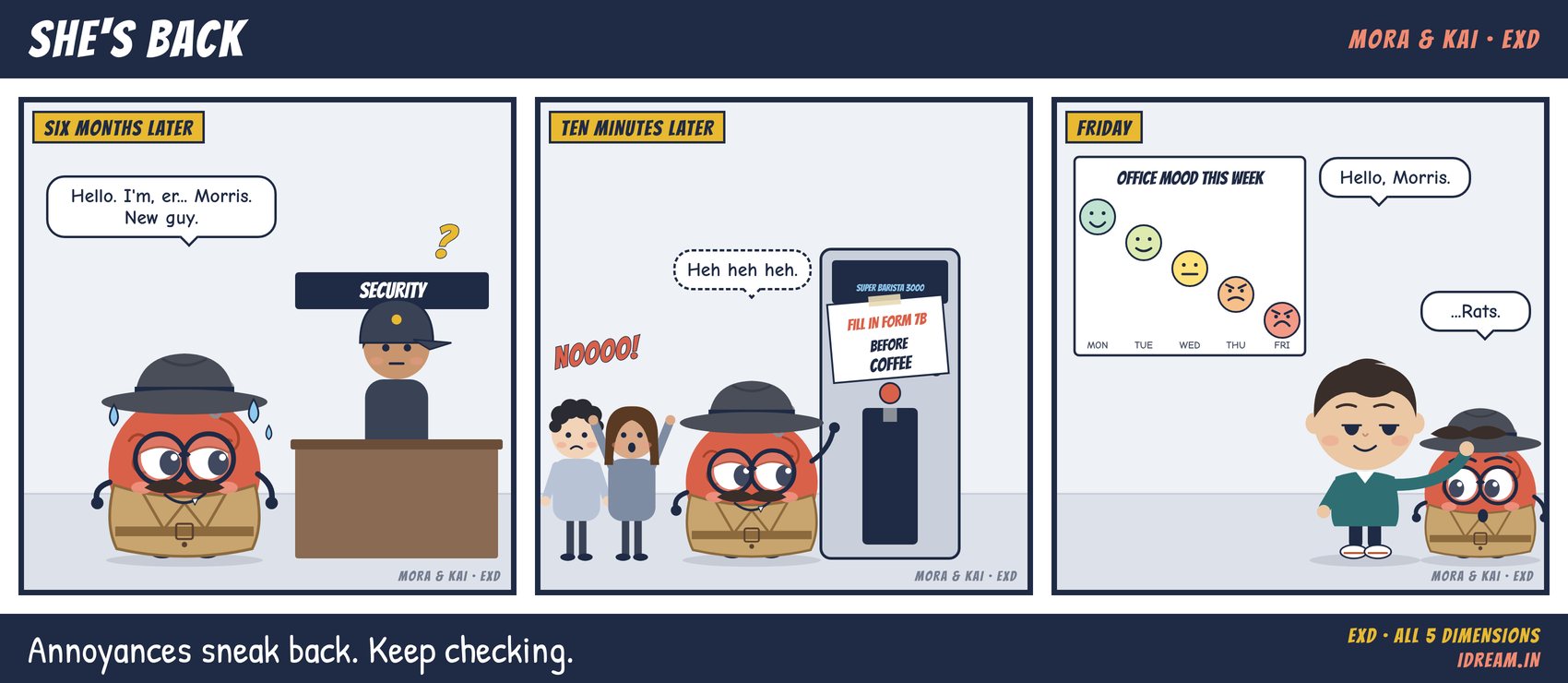
Six months after Mora was shown the door, a visitor arrived. “Morris from Compliance”, in a fake moustache, carrying just one small extra form. Nobody was fooled. Somehow, the form got approved anyway.
If you have ever cleaned up a process, you know this feeling. You cut the approvals and celebrate. A year later you look again and much of the old mess is back. Nobody voted for it. It simply returned.
Why it happens
Friction rarely comes back as one big decision. It comes back as many small ones, each reasonable on its own. A data incident leads to an extra declaration. A new manager wants a weekly report “just for visibility”. Every addition is introduced by someone trying to reduce risk, and every one is easy to defend.
Call it the “just for safety” effect. Adding a rule makes the person who adds it feel careful. The cost falls on everyone else, in tiny amounts that nobody tracks. There is no matching moment where someone is rewarded for taking a rule away, so rules pile up like sediment.
The deeper reason is that most organisations check how work feels far too rarely. An annual survey is a photograph taken once a year. By the time it shows a problem, the problem has had twelve months to settle in, and the people who could explain it may have left.
What it really costs
Each small addition looks free. Together they are not. Rough maths, purely illustrative: suppose six new small steps have crept in over a year, each costing an employee five minutes a week. That is thirty minutes a week per person. Across 1,000 people, that is around 500 hours every week, the equivalent of more than a dozen full-time roles, spent on steps nobody decided to add as a whole.
There is a trust cost too. Employees who saw a cleanup announced, and then watched the clutter return, become sceptical of the next one. “We tried that” is one of the most expensive sentences in any organisation, because it stops improvement before it starts. The second cleanup is always harder to sell than the first.
What to do instead
You cannot stop new rules entirely, and you should not try. Some are genuinely needed. The aim is to make every rule earn its place, and to notice the drift early.
- Give every new rule an owner and an expiry date. Any new form, approval or compulsory step must name the person responsible for it and a date, say twelve months out, when it lapses unless that person makes the case to keep it.
- Keep a simple register. One shared list of every step added in the past year, with its owner and review date. Look at it every quarter. Anything without an owner goes.
- Move from annual to quarterly checks. A short, regular reading of how work feels catches the slide while it is still a few small rules, not a thick layer of them. Keep it brief enough that people will answer it four times a year, and always share what changed as a result.
One warning. The register will feel like bureaucracy about bureaucracy, and Morris would approve. Keep it to a single page with four columns. If it needs its own approval process, you have already lost.
Through the EXD lens
Friction does not stay in one place, which is why this strip touches all five EXD dimensions. A new rule may start as Process, then show up in Technology as an extra screen, in Place as a locked door, in People as a frustrated manager and in Culture as a quiet belief that nothing ever really changes. The EXD Score is a 50-question check across all five, designed to be taken quarterly, so you can see which dimension is slipping and act before Morris gets comfortable.
Try this tomorrow: list every new form, approval or compulsory step added in the past six months, and write down who owns each one and when it will be reviewed.
Mora & Kai is a cartoon series from iDream about the small frictions that make work harder. Each strip maps to one of the five dimensions of the EXD Framework: People, Process, Place, Technology and Culture.
Where is friction building up in your organisation? An EXD Audit finds it and puts a cost on it. Or bring your leadership team to the next IIT Hyderabad executive programme on employee experience.