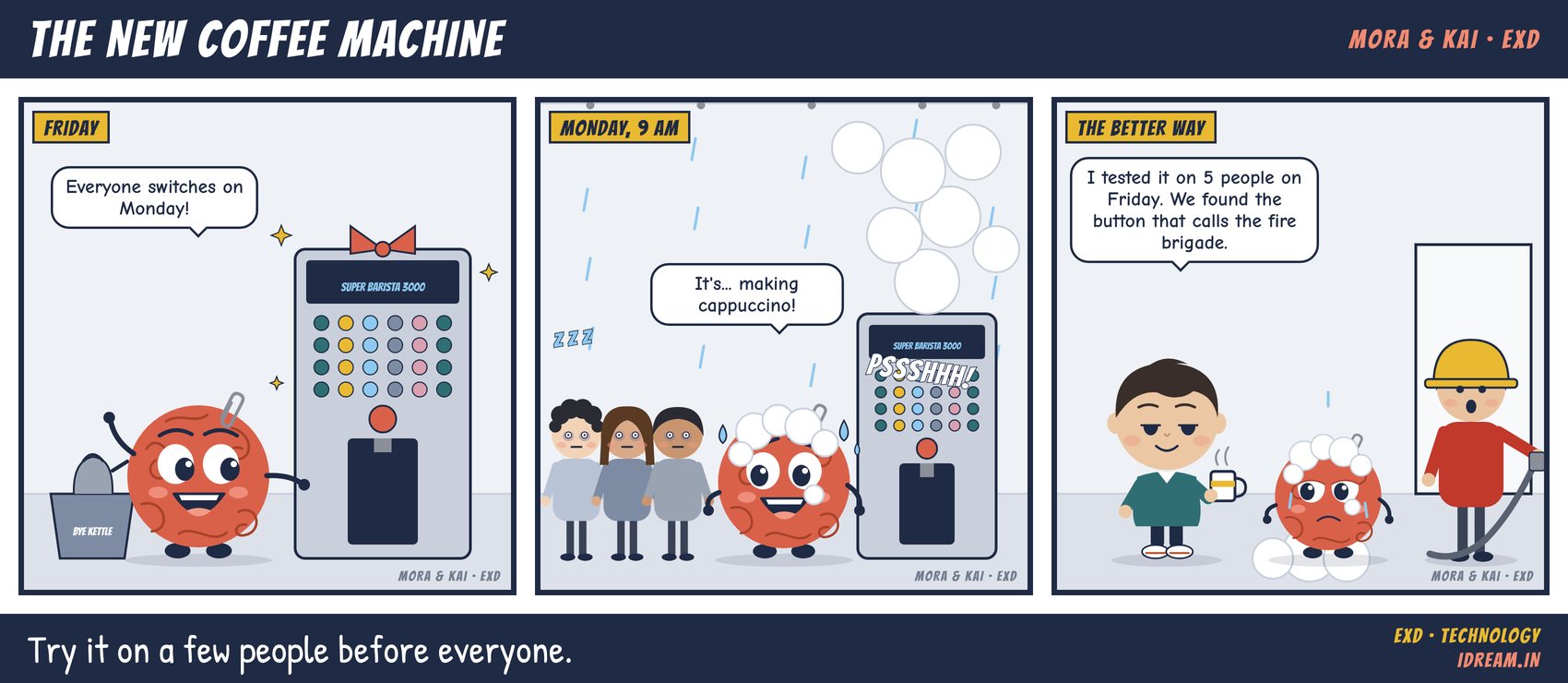
9:00 on Monday: Mora switches on the shiny new coffee machine for the entire office. 9:02: the sprinklers are going. Kai, it turns out, had tried the machine on five people the Friday before. They had already found the button that calls the fire brigade.
Most leaders have lived through the office version. A new expense tool goes live for 2,000 people on the first of the month. A new seat booking system replaces the old one overnight. By lunchtime the helpdesk is flooded and the project team is promising a fix “by end of day”.
Why it happens
Big launches are built for the announcement, not the first morning of use. The project plan ends with a go-live date and a launch email. Testing has usually happened, but by the people who built the thing, following steps they wrote themselves.
Real users do not follow the steps. They press the button that looks most like “on”, or use the tool on a phone in a cab. Each of them has some unusual case nobody thought of, and every large group contains dozens of unusual cases. A full launch is the first time all of them meet the product at once.
There is also a status problem. A pilot sounds timid. A big launch sounds confident, and it makes a better slide. So organisations choose the option that looks good on the day and pays for it in the weeks after.
What it really costs
The fault is rarely the expensive part. Bugs get fixed in days. What lasts is the first impression.
Rough maths, purely illustrative: if a broken launch costs 500 people twenty minutes each on the first morning, that is about 166 hours, or around 20 working days of effort gone before lunch. Unpleasant, but recoverable.
The bigger cost arrives later. People who had a bad first morning decide the new tool “doesn’t work”, and they keep believing it long after it does. They hold on to the old spreadsheet. They email the travel desk instead of using the portal. Adoption stalls, the business case quietly fails, and the next rollout starts with a room full of sceptics. A failed launch spends trust, and trust is much slower to rebuild than code.
What to do instead
A pilot does not need a committee. It needs a small group, a short window and a promise to act on what they find. Here is a plan that fits on one page.
- Pick five to ten people, and include the sceptics. Enthusiasts forgive problems. Sceptics find them. Add someone new to the organisation and someone who will use it on a patchy connection.
- Write down what “ready” means before you start. For example: the five most common tasks work without help, and nobody needs to fall back on the old way.
- Watch, do not demonstrate. Sit beside pilot users and let them try without guidance. Every time they hesitate, note it. Hesitation is the most useful data you will get.
- Collect workarounds in week one. If a pilot user exports to Excel, rings a colleague or gives up halfway, that is a design fault, not a training need.
- Decide openly what changes. Tell the pilot group what you fixed because of them, and what you chose not to fix and why. They will become your best advocates at launch.
It is ready to scale when pilot users stop asking questions and start using it without being reminded. If they still need the help guide in week two, so will everyone else.
Through the EXD lens
This sits under Technology in the EXD Framework. Employees do not experience a tool’s features. They experience whether it helps them on an ordinary Tuesday. Checking how people rate their everyday tools at regular intervals, before and after each rollout, shows whether a launch actually made work easier, or just made a good announcement.
Try this tomorrow: for your next rollout of any tool, policy or process, write down the names of the first five people who will try it, and include at least one sceptic.
Mora & Kai is a cartoon series from iDream about the small frictions that make work harder. Each strip maps to one of the five dimensions of the EXD Framework: People, Process, Place, Technology and Culture.
Where is friction building up in your organisation? An EXD Audit finds it and puts a cost on it. Or bring your leadership team to the next IIT Hyderabad executive programme on employee experience.